
Nebraska committee hears LB 1010 to clarify rules for large battery storage; developers warn required contracts, eminent-domain language could scare off private
Get AI-powered insights, summaries, and transcripts
Subscribe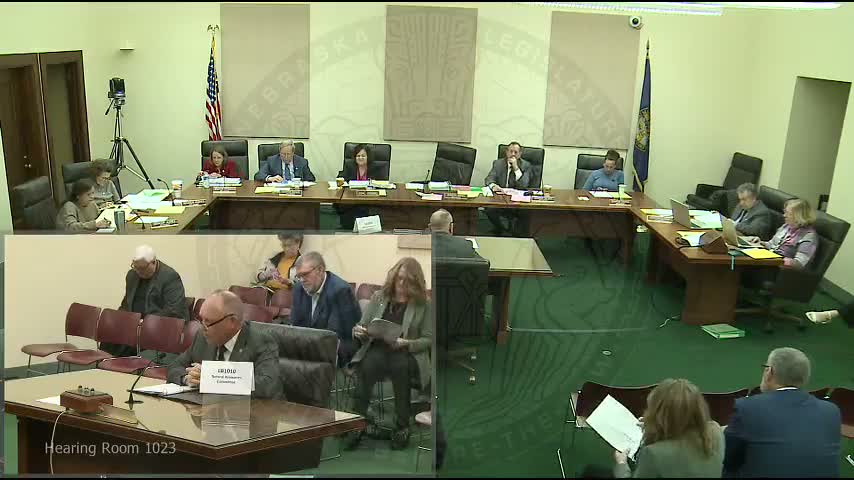
Summary
At a Natural Resources Committee hearing, sponsor Sen. Tom Brandt said LB 1010 would define energy storage resources and require Power Review Board review and a power‑purchase agreement with public power entities. Utilities backed the bill as protecting ratepayers; developers and some counties said PPA and eminent‑domain provisions risk deterring investment.
At a public hearing before the Nebraska Legislature’s Natural Resources Committee, Sen. Tom Brandt introduced LB 1010, a bill the sponsor said aims to define ‘‘energy storage resource’’ in statute and to require private developers of large battery systems to file applications with the Nebraska Power Review Board and contract with a Nebraska public power entity.
Brandt told the committee the bill’s purpose is ‘‘not to restrict or prohibit the development of battery storage in Nebraska’’ but to provide ‘‘clarity and consistency in statute’’ and ‘‘to ensure that as these resources are developed, they are done so in a way that protects Nebraska’s public power system and ultimately the ratepayers who rely on it.’’
Supporters representing public power, including Norris Public Power District and Omaha Public Power District, urged the committee to codify standards so storage projects are integrated with the state’s public‑power framework and do not create reliability or congestion problems on the grid. OPPD Chief Financial Officer Brad Underwood said study methodologies and tariff rules adopted by the regional grid operator, the Southwest Power Pool, leave some operational questions unresolved and argued the state should proceed with ‘‘prudency’’; he pointed to a recent SPP study that he summarized as showing a ‘‘98.5% chance’’ of serving load under certain assumptions to illustrate how narrow margins can be.
Private developers, represented by counsel David Levy, opposed LB 1010 as introduced. Levy said the bill’s requirement that a private project have a preexisting commercial power‑purchase agreement and that public utilities be co‑applicants before an application could proceed effectively gives utilities ‘‘veto powers’’ over whether a developer can even seek state approval. He also said the bill clarifies eminent‑domain authority over energy storage assets, a change his clients view as making large investments ‘‘unfinanceable’’ without statutory protections or an exemption. Levy offered an amendment that would require developers to offer utilities a right to contract and to respond within 60 days, and would exempt merchant storage from eminent‑domain authority.
Lancaster County Planning Director David Carey told the committee local governments have approved several projects now in development and estimated significant local tax revenue from planned facilities, citing project estimates submitted to the committee. Carey warned LB 1010 could displace local permitting decisions and reduce economic benefits counties had expected from such developments.
Environmental and clean‑energy groups voiced conditional opposition, saying they support a regulatory framework but were concerned that some provisions could hinder deployment. Ken Winston of the Nebraska Sierra Club cited a study from the American Clean Power Association estimating substantial customer savings from storage deployment across the SPP footprint.
Representing the Nebraska Power Review Board, Executive Director Tim Texel testified that the board already uses a guidance document to accept applications from private developers but that guidance is not statutory. Texel flagged technical drafting concerns in LB 1010 that could create a de facto veto by local public‑power entities and suggested the bill require applicants to present evidence rather than simply provide notice.
Lincoln Electric System’s vice president and general counsel testified as neutral, saying LES has gained more comfort through discussions with SPP but recommending a sunset clause to revisit the law as operational practices evolve.
Senator Brandt closed by thanking witnesses and noting ongoing negotiations between stakeholders. The committee closed the hearing on LB 1010; no final committee vote was recorded during the session.
What’s next: the hearing record will remain open to amendments and further negotiations; sponsors and stakeholders indicated they expect continued talks on the PPA and eminent‑domain language and asked the committee to consider technical fixes such as clarifying application standards and adding a sunset clause.