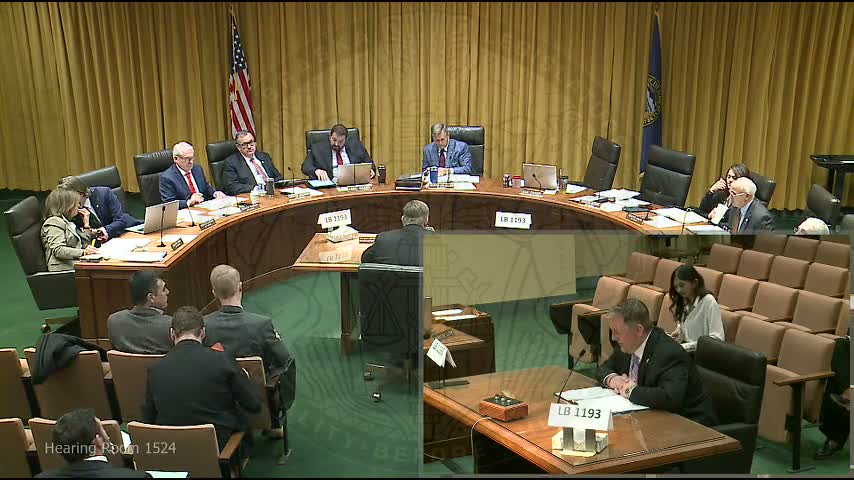
Committee weighs LB1193 to tax, regulate and encourage utility‑scale battery storage in Nebraska
Loading...
Summary
LB1193 would treat standalone energy storage as subject to Nebraska’s nameplate capacity tax, codify Power Review Board jurisdiction and safety/foreign‑adversary controls, require local first‑responder training, and bar eminent domain to attract private investment; proponents emphasized grid reliability and revenue predictability, while public power groups urged partnership safeguards and raised eminent‑domain concerns.
Sen. Jason Prokop told the committee LB1193 aims to integrate large standalone energy storage (utility‑scale batteries) into Nebraska’s tax and regulatory frameworks by: (1) subjecting storage to the nameplate capacity tax (matching renewables at $35.18 per megawatt annually), (2) codifying Power Review Board review and current guidance, (3) imposing safety and foreign‑adversary controls, and (4) protecting private projects from eminent domain to encourage investment.
Industry proponents — developers and the Advanced Power Alliance — said the proposal provides tax certainty and regulatory clarity that will attract private capital, increase capacity, and provide ancillary services that smooth price spikes. "Energy storage is the fastest way to bring new capacity to the grid," a developer representative said, and attendees described benefits such as reduced transmission upgrades and peak‑price mitigation.
Public power and rural electric associations raised concerns about guaranteeing partnership and protecting grid reliability. The Nebraska Rural Electric Association recommended LB1010 (heard in Natural Resources) as a consensus vehicle that would require public‑power partnership and power purchase agreements; NREA and Nebraska Power Association said private projects should coordinate contracts with local utilities to avoid unintended operational or rate impacts. NREA also emphasized existing authority and the need to address condemnation/condemnation waiver language.
Safety, permitting timelines, nameplate capacity valuation, and distributional impacts of the tax were discussed. Lincoln Electric System testified neutral and suggested a sunset review to reassess unintended consequences as the industry evolves. The Power Review Board guidance (Guidance Document 14) and NFPA 855 safety standards were cited in testimony.
No committee vote was taken; proponents asked the panel to advance the bill to general file for further negotiation with public power stakeholders.