Get AI Briefings, Transcripts & Alerts on Local & National Government Meetings — Forever.
Panel debates Nebraska 'Guest Worker Permit Act' that would await federal authorization
Loading...
Summary
Supporters say LB879 would prepare Nebraska to bring undocumented residents into the formal workforce if federal authorization becomes available; opponents — including the state labor commissioner — said immigration and work authorization are federal responsibilities and warned of constitutional and fiscal risks, citing Utah's unimplemented law.
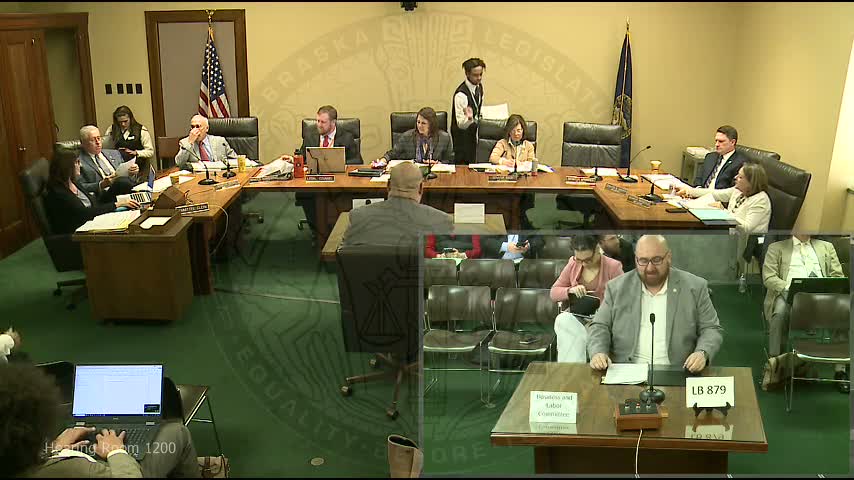
Lawmakers in the Business & Labor Committee spent a substantial part of the hearing on LB879, the proposed Guest Worker Permit Act that would create a state permit mechanism for undocumented residents to work lawfully in Nebraska — but only if the federal government authorizes or waives the necessary immigration and employment rules.
Sponsor Senator Greca opened by stressing the bill is a contingent, "triggered" approach: it "only becomes operational if and when the federal government authorizes or expands the lawful employment pathway." He said the bill is modeled on state-level programs used elsewhere and is intended to provide orderly guardrails so Nebraska employers and families can benefit when federal policy changes.
Committee questioning focused on technical and constitutional issues. Senators queried the bill's definitions (including the scope of "family member" eligibility and why the bill uses 21 years for certain dependent rules), the required "basic health insurance plan" standard and how an undocumented applicant would obtain such coverage, a 30‑day window for permit application after entering a contract, criminal‑background exclusions, fee amounts ($1,000 for illegal entry, $2,500 otherwise), whether employers or third parties could pay fees, how income tax withholding would be handled if the permit holder lacks a Social Security number, and the meaning of "actively participate" for gubernatorial involvement. Sponsor acknowledged many drafting details could be tightened and repeatedly emphasized the bill's dependence on federal action.
A broad coalition of proponents appeared. Connor Herbert (Nebraska Commission on African American Affairs) framed the bill as a law‑respecting, practical way to reduce underground employment and strengthen compliance with labor and tax laws. Construction trades, retailers, the Nebraska State AFL‑CIO, Nebraska Farmers Union, and business coalitions said the state faces workforce shortages across agriculture, construction, health care, and hospitality, and that a permit system would allow workers already in the state to contribute lawfully. Several witnesses referenced fiscal-note estimates that tens of thousands of people could be eligible.
Opposition centered on constitutional and feasibility concerns. Katie Thurber, Nebraska's Commissioner of Labor, told the committee states are prohibited from creating parallel immigration frameworks and warned Utah's similar law has never been implemented because required federal waivers were not granted. Thurber said LB879 could impose significant administrative costs on the state to build an infrastructure that may never be legally permitted to issue a single permit.
Committee members also asked whether any states have successfully obtained the necessary federal waivers; witnesses were not able to point to an example of a state that had received the approvals. The sponsor closed by urging the committee to start a conversation and noting wide workforce deficits reported by local studies.
Ending: The hearing produced detailed technical questioning and a split between pro‑business and administrative/legal concerns; committee amendments to tighten definitions and to address the procedural questions raised are likely before further action.