Get Full Government Meeting Transcripts, Videos, & Alerts Forever!
Get email alerts on the Marine Mammals Right Whales topic
No spam. Unsubscribe anytime.
Maine panel hears DMR plan to give emergency rule authority to protect North Atlantic right whales
Summary
The committee heard DMR and industry testimony on LD 20 13, a bill to let the Commissioner of Marine Resources adopt narrow emergency rules to limit take by gear or location to protect endangered marine mammals. DMR cited a Jan–Feb 2025 aggregation of right whales and the measure would add a report‑back requirement to the legislature.
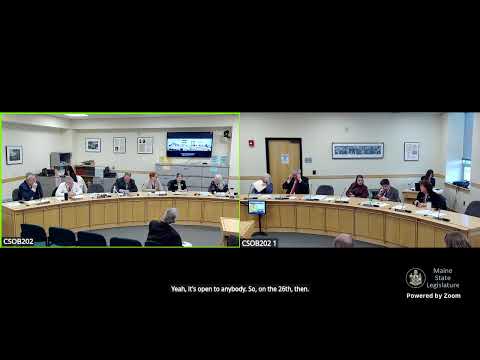
The Joint Standing Committee on Environment and Natural Resources heard testimony on LD 20 13, a Department of Marine Resources bill that would let the commissioner adopt emergency rules to limit the taking of marine organisms by gear or location in order to protect endangered and threatened marine mammals. Representative Lisonbee Hepler sponsored the bill and introduced the committee to the measure.
Commissioner Carl Wilson described the urgent need for the authority after an “unprecedented aggregation of over 90 endangered North Atlantic right whales offshore Maine” in January and February 2025, a period when whales lingered near Jeffreys Ledge for weeks in an area with heavy lobster fishing. "This bill would authorize the commissioner of DMR to adopt emergency rules to limit the taking of marine organisms by method or location for the purpose of protecting endangered and threatened marine mammals," Wilson said, adding that current emergency rulemaking under Title 12 is constrained and "would not allow the department to implement an emergency closure" for such an event.
DMR told the committee that existing emergency authority under Title 12 (sections cited in testimony) treats rules for protecting another marine organism as major substantive rules and generally bars emergency adoption for that purpose. LD 20 13 would create a narrow exception so the department could act dynamically—short, targeted closures or gear limitations—when there is an exceptionally high level of entanglement risk. Wilson framed dynamic management as a tool to reduce the likelihood of larger, longer static closures in future federal rulemaking and said the bill includes a requirement that DMR report back to the legislature with findings and recommendations.
The Maine Lobstermen’s Association, represented by Patrice McCarron, testified in support, saying the industry took voluntary steps during the aggregation and that researchers identified "96 unique right whales" during the event. McCarron said state authority to act in real time would allow Maine to work with fishermen and other states to design flexible responses that limit economic harm while protecting whales; the MLA offered three proposed amendments that would require consultation with industry, reauthorization on the appointment of a new commissioner, and an explicit limit of the authority to North Atlantic right whales.
Committee members pressed DMR on operational details: how many fishermen were operating in the sighted area (DMR estimated about 40), how compliance with voluntary requests was tracked (DMR said information is incomplete), whether ropeless gear would be permitted to access closed areas (Wilson said ropeless access is one option but the bill’s language should be clarified), and how much notice fishermen would receive to remove gear in winter seas. DMR agreed to bring further information to the work session, including data on ropeless gear use and suggested timeframes for closures.
The public hearing was closed and the committee asked DMR to refine wording on ropeless gear and closure timing for the work session. The bill includes a requirement for DMR to report back to the legislature (language in the bill as discussed), and committee members signaled they want the department to coordinate with Massachusetts and New Hampshire before implementing any dynamic management approach.
Next steps: DMR will provide the committee with additional details at the work session, including counts or estimates of ropeless gear users and proposed notice periods or other operational safeguards; the committee may consider MLA’s suggested amendments and language clarifications in follow‑up work.