Get Full Government Meeting Transcripts, Videos, & Alerts Forever!
Get email alerts on the Infrastructure topic
No spam. Unsubscribe anytime.
Crescent City adopts ordinance to enable undergrounding utility district, aims to shield property owners from costs
Summary
Council approved Ordinance 8.54 to update Chapter 12.28, authorize undergrounding utility districts, and allow Rule 28 work credits to cover distribution and lateral line costs so private property owners are not charged.
Crescent City’s council adopted Ordinance 8.54, updating municipal code Chapter 12.28 to streamline formation of undergrounding utility districts and allow projects to be funded entirely with Rule 28 work credits.
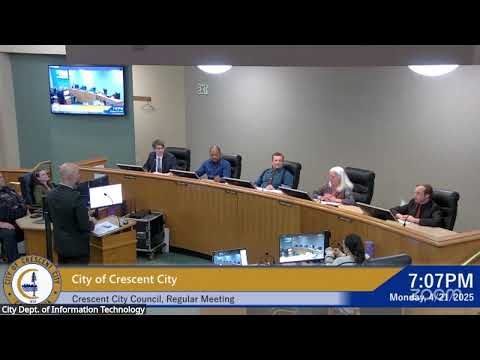
City Attorney Rice presented the ordinance and the proposed district boundary for a phased project that begins on Front Street and includes portions of K and H streets. Staff said the work is planned to use $2.8 million in Pacific Power work credits and that the city will seek $2.4 million in county credits; both sets of credits must be committed by June 8 or they will expire. Rice told the council the update would allow the city to apply work credits to lateral service lines so that private property owners would not be required to pay for those portions of the work.
Rice summarized the implementation schedule and public‑hearing timeline: public notices have been mailed to property owners and utilities in the proposed boundary; the council will hold a public hearing on May 5 and may adopt a resolution forming the district after that hearing. Council voted unanimously 5–0 to waive reading by title and proceed with the ordinance.
Rice framed the policy goal plainly: “Our goal is that no private property owners have to expend money as part of this project.” The council was told the ordinance includes qualifying findings the council must adopt when creating a district.
The council’s approval advances a targeted program to convert overhead utility lines to underground lines in defined phases, contingent on the timely commitment of work credits from the utility and county.