
Subcommittee hears bill to allow campaign funds for security with disclosure and enforcement
Get AI-powered insights, summaries, and transcripts
Subscribe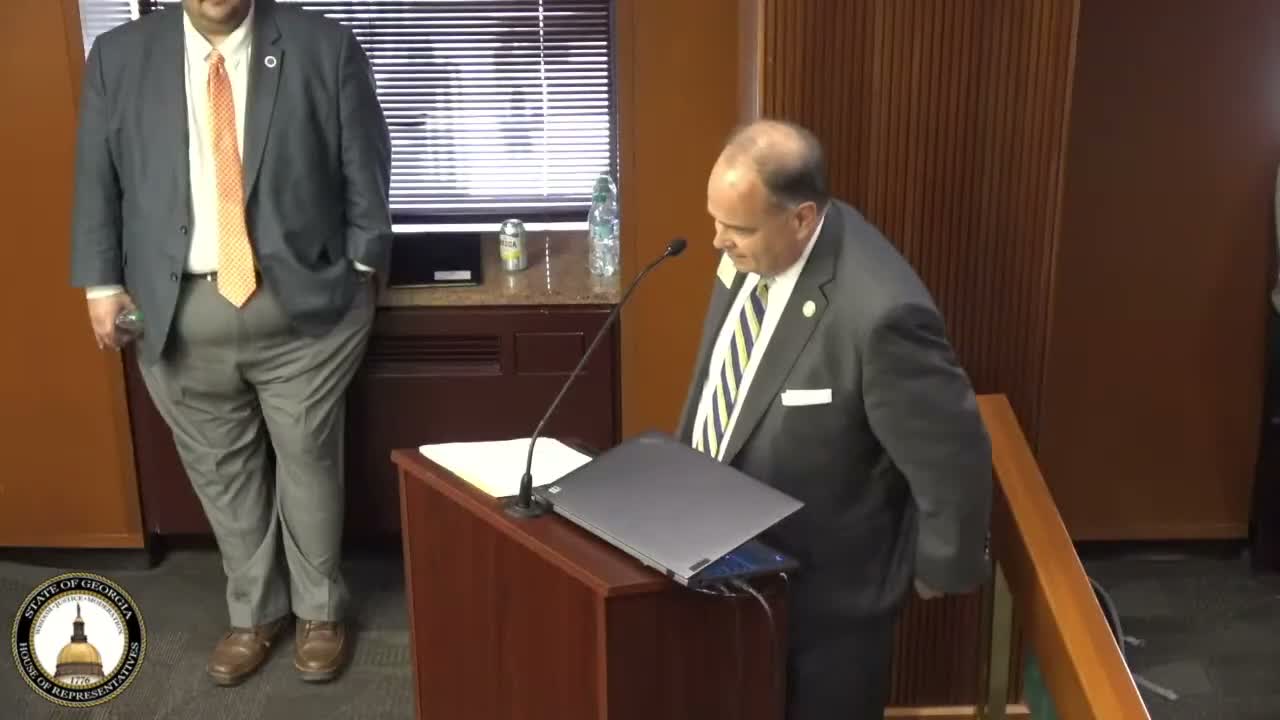
Summary
Representative Seeball presented House Bill 1130 to codify an Ethics Commission 2021 advisory and allow campaign funds for reasonable security costs while banning weapons and requiring licensed installers, itemized reporting and penalties for refusal to comply with inspections. The subcommittee held the bill for further consideration; no vote was taken.
Representative Seeball, the floor leader, presented House Bill 1130 (LC473937), calling it “a straightforward transparency and accountability bill” that would allow candidates and elected officials to use campaign funds for "reasonable cost for security equipment and monitoring services," while restricting purchases such as firearms and ammunition and requiring licensed professionals to perform installations. Seeball said the bill codifies an Ethics Commission memorandum from 2021 and adds reporting and documentation requirements.
The bill would require campaigns to list purchased security equipment on disclosure reports and sets a 30-day deadline for complying with lawful inspection requests from the State Ethics Commission. David Amati, director of state ethics compliance, told the committee that "currently, there is no penalty for refusing to comply with that legal requirement," and that the proposed language would mirror other enforcement mechanisms and allow administrative penalties similar to existing code, "up to $1,000 for the first offense." Amati said the commission already has statutory authority to request campaign bank records but lacks an enforcement consequence for refusal.
Members asked whether the requirement for a "licensed security professional service" would bar common consumer devices or in‑house installations; Seeball said the provision is intended as a guardrail so "I can't hire my son and pay him $10,000 to put in a ring doorbell camera." Committee members also sought clarity on whether the provision applies only to cameras; Amati said the advisory opinion underlying the bill extends to other security measures when necessary for an officeholder's protection.
Kyle Gomez Lineweber, policy director for Common Cause Georgia, testified in support of the bill's transparency goals but asked the committee to clarify what counts as "reasonable cost" and to close any loopholes that might allow personal home‑improvement spending to be recharacterized as security equipment: "We see the benefits of clarifying that campaign funds can be used for reasonable security needs," he said, "but we do have some questions about what counts as reasonable cost."
The subcommittee did not take a vote. The chair said the bill will be placed on the full committee calendar for further consideration; the committee's rules do not require a subcommittee vote for a bill to advance.