
VIPD outlines camera expansion, RTCC and drone plans; consent-decree progress reported
Get AI-powered insights, summaries, and transcripts
Subscribe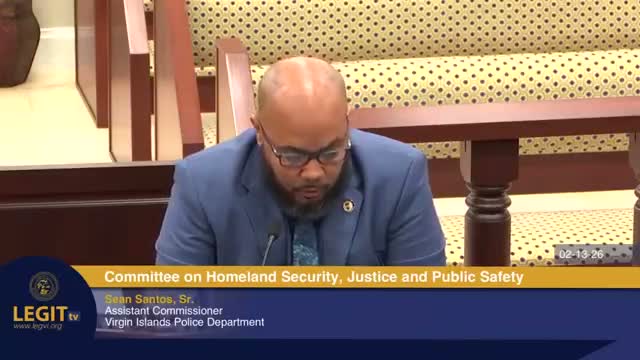
Summary
Assistant Commissioner Sean Santos told the committee VIPD completed phase 2 of its territory-wide camera expansion and is integrating real-time crime center software; the department aims for RTCCs and a drone-as-first-responder program to be operational by midyear and reported progress toward consent-decree compliance.
The Virgin Islands Police Department told legislators on Feb. 13 that it is advancing a multi-part technology modernization while continuing work on the federal consent decree.
Assistant Commissioner Sean Santos said the department has "successfully completed phase 2" of a territory-wide public-safety camera expansion and that a license-plate-reader pilot is fully installed and operational. He described the completion of RTCC phase 1 hardware and said phase 2 software integration is underway; his office advised the committee that the department—s strategic objective is to have both real-time crime centers fully operational by July.
Santos described a drone-as-first-responder program that will provide rapid aerial situational awareness to police and fire/EMS. "For right now, we're just using the drone for different type of operations that are outside of any type of violation of privacy of residents," Santos said, and he told senators that formal privacy policies are being finalized before full program deployment.
On the federal consent decree, Santos said VIPD has a hearing scheduled for Feb. 26 with the monitors and judge and expressed an expectation to reach substantial compliance on some paragraphs this year.
Committee members pressed for details on several operational fronts: vehicle maintenance and procurement (Santos said new police-package vehicles will be pre-configured on the mainland to avoid prior local fit-out delays), GPS and monitoring in patrol cars (newer vehicles include tracking modules; older cars can be fitted), a timeline for drone rollout (targeted this year, with launch hoped for by July) and the red-light enforcement pilot (scope of work and bidding under way with pilot funding identified).
Santos provided camera counts to the committee when requested: 130 cameras in St. Thomas and 126 in St. Croix. He said the department holds footage and maintains redundancy with vendor systems for resilience. The department acknowledged cybersecurity is an ongoing cost and that software integration and analytic platforms (FUSUS, Rock Solutions) are part of the RTCC build-out.
Senators also discussed e-ticketing, report submission timeliness, redeployment of officers to patrol and cadet/recruitment programs. Santos said supervisors are now double-checking report submissions after a recent RMS transition, e-ticketing is being rolled out in phases and new recruit classes are expected to begin by March with continued efforts to place officers into patrol after graduation.
The committee encouraged closer public outreach on school-bus safety and traffic enforcement; VIPD chiefs described public-service campaigns and highway-safety operations to address reckless driving and school-bus overtaking.
The department closed by thanking the committee and community and promising follow-up material and timelines for the RTCC, drone and red-light initiatives.