
Vermont committee reviews draft letting banks pause suspect transactions for up to 15 business days
Get AI-powered insights, summaries, and transcripts
Subscribe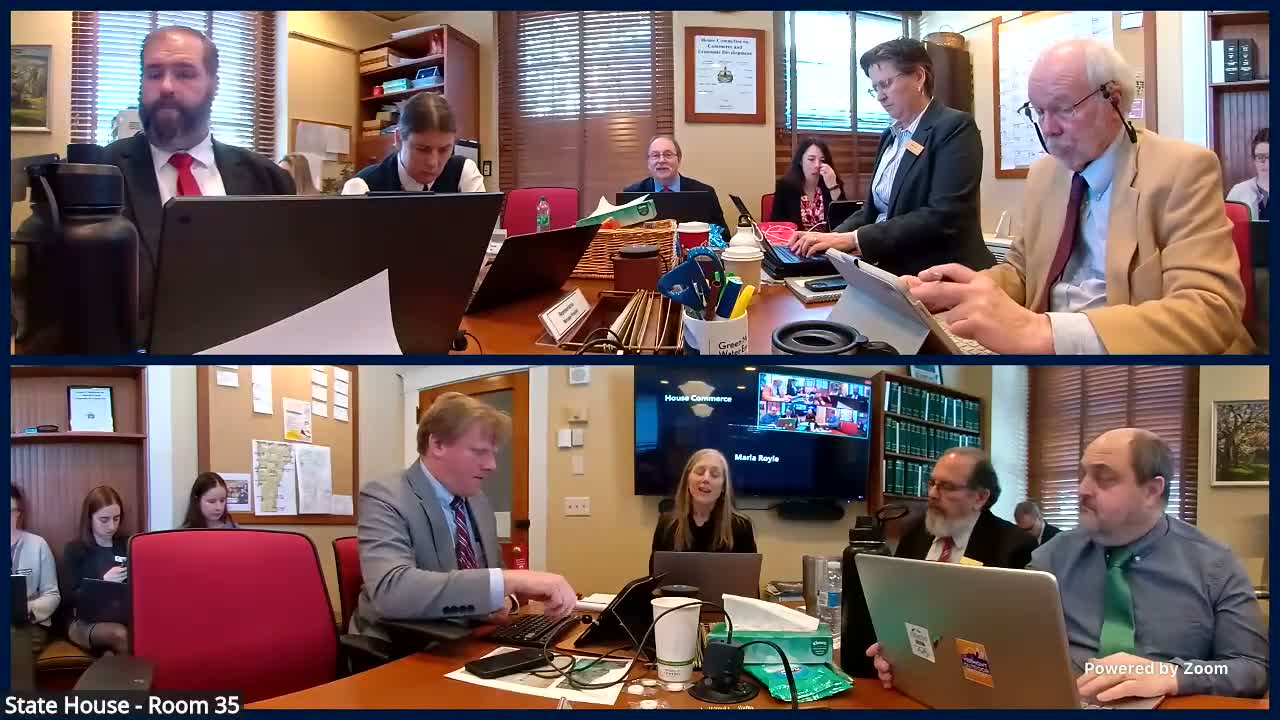
Summary
The House Commerce & Economic Development Committee reviewed draft language to allow banks and credit unions to delay customer-directed transactions when they reasonably suspect financial exploitation, with limits on notification, a 15-business-day hold (plus a possible 15-day extension), and legal safe harbors; bankers supported the discretionary approach but members pressed on privacy, documentation, and coverage of federally chartered institutions.
The Vermont House Committee on Commerce and Economic Development examined draft legislation that would let banks and credit unions temporarily delay or refuse customer-directed transactions when they reasonably suspect financial exploitation.
Maria Royal of the Legislative Council, who walked the committee through the language, said the proposal would add a new subchapter to Title 8 (Chapter 200) to give covered entities tools to protect customers while preserving access to funds. Royal read the bill's intent and definitions, saying the measure would apply to "banks and credit unions" and would define financial exploitation to include the "wrongful or unauthorized taking, withholding, appropriation, transfer, expenditure or use of a customer's money, assets, or property" through deception, coercion or undue influence.
Under the draft's central provision, a covered entity that "reasonably believes" a customer is or has been the victim of financial exploitation could take steps including delaying or refusing transactions, refusing withdrawals or disbursements, preventing changes in account ownership or beneficiary designations, and refusing to honor instructions purportedly from an agent under a power of attorney. Royal said the authority is discretionary and tied to specified triggers and time limits.
The draft sets an initial limit on delay that expires at the earlier of three outcomes: 15 business days after the covered entity initiated the delay; a determination that the transaction is unlikely to result in exploitation; or a court order directing release of funds. The bill also allows a one-time extension "for up to an additional 15 days" if the covered entity reasonably believes exploitation may continue.
Bankers who testified urged the committee to keep the authority discretionary. "The 15 days is in my words, nobody else's a cooling off period," said Chris Delia of the Vermont Bankers Association, describing the timeframe as a period for internal escalation, customer outreach and, when appropriate, coordination with law enforcement. Delia said banks already document unusual activity through currency transaction reports and suspicious activity reports and that state-chartered examiners review those files.
Committee members pressed on privacy and safety trade-offs when notifying associated third parties listed in the draft—such as parents, spouses, adult children, co-owners, and court-appointed fiduciaries. Royal summarized the bill's limits: a covered entity "may notify an associated third party, if any, if it reasonably believes that the financial exploitation or attempted financial exploitation of a customer is or has occurred and such disclosure is in the best interest of the customer," but may withhold notice if the third party is suspected of involvement. The draft also limits disclosures to only the information "necessary to convey its suspicion" and states such disclosures are exempt from the chapter's financial privacy protections to the extent permitted by federal law.
A committee member cautioned that contacting a third party could itself endanger a customer. "I'm just wondering if if that could put them in danger," the member said. Royal acknowledged the concern and noted the bill attempts to restrict disclosures and preserve customer privacy where possible.
Members also asked whether federally chartered banks would be covered and whether the committee could require reporting or data collection. Royal said the statutory definition points to financial institutions generally and that she would confirm whether federally chartered banks fall within the draft's scope; Delia offered to survey association members and provide aggregate data on how the tool performs in practice.
Delia emphasized the need for frontline training and careful procedures so staff know when to escalate and how to document decisions. He said some reporting already exists but acknowledged limits on state access to suspicious activity reports, which are filed with the Financial Crimes Enforcement Network.
The committee did not take any formal votes on the draft during the session. Members asked staff and stakeholders to refine language on notice at account opening, documentation standards, and the role of a designated trusted contact. The Vermont Bankers Association agreed to return with aggregated survey data; the committee scheduled additional presenters at 11:30 and took a 20-minute break.