
Mountlake Terrace consultants propose brand centered on 'people and nature' after community feedback
Get AI-powered insights, summaries, and transcripts
Sign Up Free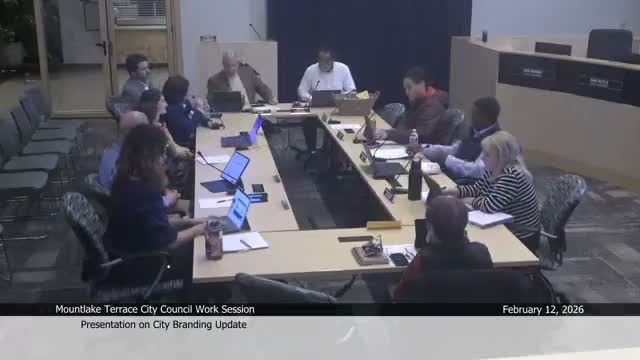
Summary
Consultants presented two refined directions — a human‑centered approach and an outdoors/nature approach — and will return in March with two cohesive brand systems and implementation guidance that staff said will feed into future budgets for signage, wayfinding and marketing.
Consultants from Altogether told the Mountlake Terrace City Council on Feb. 2 that the city’s branding project should emphasize residents and natural amenities, and proposed two campaign directions intended to guide future signage, public art and promotion.
The city’s communications and economic development staff introduced the update, saying the project’s discovery phase included 16 stakeholder conversations and more than 300 survey responses. Rachel Oziz, co‑founder of Altogether, said the team heard consistent strengths — "light‑rail access, the parks and natural amenities, proximity to Seattle" — and recurring concerns about "loss of affordability" and "overdevelopment." The consultants said they will present two refined brand systems in March and develop wayfinding and placemaking recommendations for future implementation.
Why it matters: Council members said a clear, concise positioning line and actionable marketing steps will help the city attract visitors and compatible investment while preserving local character. Staff advised that implementation decisions (new signs, public‑art placements, wayfinding and campaign execution) will be budgeted in future decision packages for the 2027–28 cycles.
Altogether presented three initial visual directions — modern/bold, human and emotional, and nostalgic/outdoorsy — and reported that feedback from a recent open house tended to favor a blend of the human and outdoorsy options. Oziz summarized one proposed message as: "Mountlake Terrace is a small, diverse community in the Greater Seattle region with new transit access that is positioned for thoughtful growth that enhances character and connectedness." She added that the consultants are not proposing to redesign the city’s primary logos but to create a system for how the brand shows up across departments and public places.
Council members focused questions on outreach and implementation. "Did you talk to kids or were all of these respondents adults?" Councilmember Doyle asked; Oziz and staff said surveys skewed toward ages 30–50 and that mood boards or visual exercises would be used to engage youth in the next phase. Councilmember Page urged more youth involvement and suggested leveraging the pavilion and schools to capture children’s feedback.
Council discussion also addressed wayfinding and the role of the Arts Commission. Staff clarified that the Arts Commission retains decision authority for individual public‑art selections and that the branding project will provide guidance — not mandates — to inform future public‑art and streetscape opportunities. On budgeting, staff said marketing and implementation recommendations will be included in future budget decision packages so the council can prioritize investments.
A number of council members asked the consultants to pare the narrative down to a succinct regional sentence that council and staff can widely use. Mayor Pro Tem Wall and others signaled support for a blended approach that foregrounds the city’s people and parks while allowing room for a vibrant marketing campaign to attract visitors and thoughtful investment.
The consultants will return in March with two refined brand systems, conceptual signage and early wayfinding ideas for further council feedback and direction. The work session closed with the council thanking the team and asking staff to include recommendations for youth engagement and clearer, shorter positioning language in the next presentation.