Get Full Government Meeting Transcripts, Videos, & Alerts Forever!
Get email alerts on the Flood Mitigation topic
No spam. Unsubscribe anytime.
Grand County weighs FEMA BRIC bid for $33M Pack Creek flood project amid steep local match
Summary
County engineers and staff outlined a large detention‑basin alternative for Pack Creek intended to reduce flood flows to roughly a 20‑year event. The proposed FEMA BRIC application would be highly competitive but requires a 25% county match (estimated $6–9M), prompting commissioners to delay a formal commitment while exploring lower‑cost options and partner contributions.
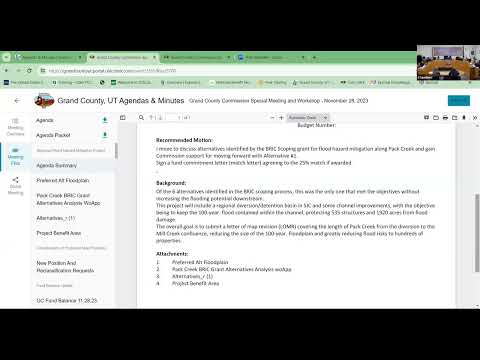
Grand County engineers presented a recommended flood‑mitigation alternative for Pack Creek on Nov. 28, saying a large detention basin and channel improvements could reduce peak flows downstream and protect several properties. The work would include channel armoring, easement procurement and a roughly 55‑acre storage basin upstream, county staff said.
Staff outlined funding options and tradeoffs. The county intends to submit a Building Resilient Infrastructure and Communities (BRIC) grant application to FEMA, a national program for resilience projects; BRIC grants require a local match, usually 25 percent. Preliminary planning documents put the project cost at roughly $33 million, with the county match in the $6 million–$9 million range depending on final estimates and whether some land is available by exchange rather than purchase.
County floodplain staff and engineers told commissioners the BRIC route could be the most competitive path for a capital‑intensive basin that pairs detention with channel work to prevent increased flows downstream. Staff also described alternate funding tracks — including NRCS and PL‑556 programs — that can finance debris basins or erosion control but can be slower or narrow in scope.
Commissioners raised two main concerns. First, the immediate affordability of a multi‑million‑dollar local match during a budget season with competing needs. “That’s a big chunk of money,” one commissioner said, noting the county’s other capital priorities and the tentative budget gap. Second, commissioners questioned whether upstream actions by other jurisdictions could shift water‑rights or recharge outcomes; staff said San Juan County has proposed parallel work and offered to maintain features on its land, but the projects and rights remain separate. Staff also said appraisals are pending (about four weeks out) and easement values could significantly affect the benefit‑cost ratio used by FEMA reviewers.
No formal vote was taken. Commissioners asked staff to pursue lower‑cost alternatives and identify potential partner contributions (city, San Juan County and other beneficiaries) before making a formal commitment. Staff said the BRIC timetable is short and state screening begins in December/January; they asked whether the county would authorize a signed commitment letter for the application. Commissioners instead requested additional analysis and smaller‑scale options to reduce the required match and risk.
Next procedural step: staff will return to the board with refined costings, possible partner match scenarios and other grant paths. The BRIC application deadline and state screening schedule make an expedited timeline likely; commissioners signalled they prefer more information before binding the county to a large match.