Get Full Government Meeting Transcripts, Videos, & Alerts Forever!
Get email alerts on the Water Infrastructure topic
No spam. Unsubscribe anytime.
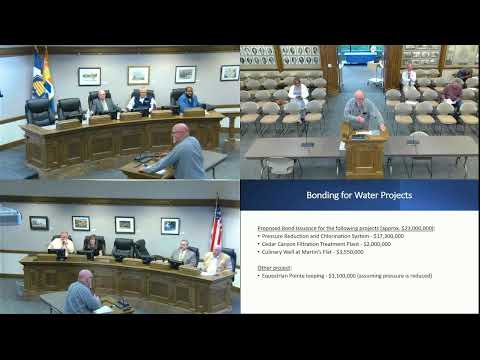
Cedar City Council debates $22–23 million water bond and alternatives amid state compliance deadline
Summary
Council spent the bulk of a May work session on a proposed multi‑million dollar water bond to address chlorination, pressure reductions and new wells, debating staging, cost uncertainty and whether to seek conservancy district repricing before borrowing.
Cedar City Council devoted the majority of its May work meeting to a contentious review of proposed fiscal‑year 2025–26 water projects and a $22–23 million bonding package intended to pay for chlorination, pressure‑reducing upgrades, new pumping and storage capacity, and pipeline work to bring northern supplies into the city.
City engineering staff outlined a multi‑phase plan that includes a filtration/chlorination facility for Cedar Canyon Springs (engineered estimate about $4.2 million), pressure‑reduction work in the North Quichespah well field, additional pumping capacity and a storage tank near 800 South, meter replacements and a pipeline loop to increase system redundancy. Jonathan Stath of the City Engineering Department told the council the Division of Drinking Water has required chlorination in sections of the culinary system and that staff aim to present “a realistic timeline” for compliance that the state can accept.
The mayor and several councilmembers urged more study and a second price review. “I think we need to study it longer,” the mayor said, pressing for additional analysis and at least brief forbearance to reprice the work with the regional water conservancy district and seek lower costs or alternate designs. Councilmembers discussed options including staging bonds, using existing budgeted funds for immediate needs, and leaving large bond authorization in the tentative budget without immediately issuing debt.
Council debated tradeoffs: delay could buy time to seek lower proposals and conservancy district input, but staff stressed that filtration and chlorination work is time‑sensitive because of regulatory compliance. “They want us to give a realistic timeline and then they would be willing to work with us,” Stath said of the Division of Drinking Water. Staff noted some projects could be staggered and that leaving the larger authorization in the tentative budget would not obligate the city to bond immediately.
Several well proposals were discussed as potential low‑cost sources of additional supply, including a private well offer on Rush Flats (described by the mayor and others). Council asked for clarity on the cost and contractual terms of private well options, off‑ramps if quality or quantity tests fail, and the long‑term pipeline costs to bring water to town. Council members also discussed drilling additional test wells (Martin’s Flat) and the merits of buying finished wells vs. funding test drilling.
Council did not take final votes on bonding at the meeting. Staff were asked to consult further with the Division of Drinking Water about feasible timeline extensions, to contact the conservancy district for re‑pricing or a second opinion, and to return with refined estimates and funding scenarios so the council can weigh whether to issue bonds and how to sequence projects.