Get Full Government Meeting Transcripts, Videos, & Alerts Forever!
Get email alerts on the Economic Development Grants topic
No spam. Unsubscribe anytime.
State economic office briefs Grand County on rules and uses for $200,000 county grant and competitive rural funds
Summary
State officials from the Governor's Office of Economic Opportunity (GOEO) trained Grand County commissioners and advisory board members on County Economic Opportunity (CEO) board requirements, the annually guaranteed $200,000 Rural County Grant (RCG), and the competitive Rural Communities Opportunity Grant (RCOG), including eligibility tests, reporting deadlines and examples of successful projects.
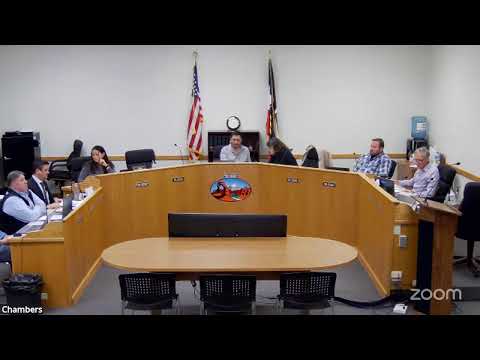
James Dixon, director of Community Grants at the Governor's Office of Economic Opportunity, told the Grand County Commission on March 18 that County Economic Opportunity (CEO) advisory boards are established by state statute and are prerequisites to administering two state rural grant programs. "The County Economic Opportunity Advisory Boards, which we call CEO boards, are established by state statute," Dixon said, describing required membership categories and governance rules.
Dixon described three core responsibilities of CEO boards: advising commissioners on applications for the Rural County Grant (RCG) and the Rural Communities Opportunity Grant (RCOG), helping prepare annual reports, and recommending projects appropriate for economic development funding. He said the RCG is "a $200,000 a year grant" guaranteed to counties that meet the statutory criteria and that the board must be operational for the county to receive the pass-through.
On the competitive RCOG program, Dixon said GOEO awarded about $5,400,000 last year across 12 awards from roughly 30 applications and expects approximately $5,250,000 for FY26. Applications for that competitive round will open in October; GOEO will offer an intent-to-apply pre-application starting Aug. 1 to allow consultation and technical feedback.
Dixon gave examples of projects that have won or used state rural funds: workforce training (CDL and contractor licensing), a youth entrepreneurship program in Emery County, downtown revitalization projects in Vernal, site-ready industrial parcels in partnership with EDCUtah, business marketing programs, innovation centers and subgrant models that distribute small awards to local businesses. He emphasized that proposals with solid budgets, bids and clear deliverables perform best in scoring.
To help commissioners decide whether a proposal qualifies, Dixon presented two scenarios: general community infrastructure that broadly benefits residents (classified as community development and usually not appropriate for RCG/RCOG) versus targeted infrastructure that directly enables business expansion and jobs (which is considered economic development and is appropriate for RCG/RCOG). "Under scenario 2, the new electrical infrastructure will directly affect business growth and employment opportunities," he said.
On eligible uses, GOEO staff said small counties have sometimes used RCG funds to support a local economic-development position (Dixon gave a past example of about $40,000 per year for staffing in a very small county). They also said RCG/RCOG funds can pair with other sources, including federal broadband last-mile funds, when the project clearly supports business activity.
Commissioners pressed staff on edge cases. Chris Wilson, chair of the county's economic opportunity advisory board, asked whether programs that touch K-12 students could be funded. GOEO responded that public education funding is separate; county-run or chamber-run after-school entrepreneurship programs that are not part of the public-school budget can be eligible. When commissioners asked about the Beacon After School Club (a nonprofit after-school program), GOEO staff said that if the program functions primarily as child care enabling parents to work it might be routed through a childcare funding pathway; as an enrichment-style after-school program it may score lower on economic-development criteria and counties should weigh priorities.
GOEO staff also addressed recusals and conflicts of interest: they advised disclosure and recusal from voting where a board member has a material interest, and described internal safeguards GOEO uses to avoid staff reviewers scoring applications where they provided prior assistance. GOEO staff encouraged commissioners to consult county attorneys or state staff on specific cases.
GOEO offered technical assistance and printed materials and said they would update the slide deck to reflect new county population classifications and distribution rules. They invited counties to use the Aug. 1 intent-to-apply process and to contact GOEO staff directly for consultation.
The training concluded after a broad Q&A; later in the meeting the commission voted to enter a closed session for pending litigation.