Get Full Government Meeting Transcripts, Videos, & Alerts Forever!
Get email alerts on the Land Use Administration topic
No spam. Unsubscribe anytime.
State land‑use trainer briefs Grand County Planning Commission on SB 174, administrative authority and timelines
Summary
Rob Terry of the Office of the Property Rights Ombudsman gave a Land Use 101 briefing covering the Land Use Development and Management Act, Senate Bill 174 (2023), administrative land‑use authority, review timelines (15/20 business days), four‑cycle review limits, exactions and variances. Commissioners raised staffing and conflict‑of‑interest concerns.
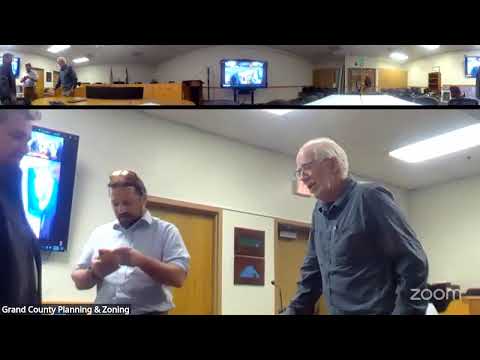
Rob Terry, statewide land‑use training director for the Office of the Property Rights Ombudsman, told the Grand County Planning Commission on Feb. 24 that the state’s Land Use Development and Management Act is the bedrock of local land‑use authority and that recent statutory changes shift several procedural responsibilities to administrative review.
Terry said the ombudsman’s office is neutral and there to help both local agencies and property owners: "we are neutral and we're an independent agency," he said, and encouraged commissioners to use the Land Use Academy of Utah as a training and reference resource.
Why it matters: Terry outlined how Senate Bill 174 (2023) and related provisions create an Administrative Land Use Authority (ALUA) framework intended to reduce politicized delays and speed housing development by moving certain subdivision and ministerial approvals to administrative review. Key statutory timelines Terry highlighted: agencies must schedule a requested pre‑application meeting within 15 business days; preliminary plat initial review must be completed within 15 business days for municipalities over 5,000 population; final plat review must be completed within 20 business days; and the statute limits review to a maximum of four review cycles before an application may be deemed denied.
Terry cautioned that the timelines carry operational nuance. "If it checks the boxes, approve it and move on," he said, but added that agencies must still exercise good faith, particularly when late‑discovered health and safety issues arise. He also urged clear documentation to ensure decisions are supported by substantial evidence in the event of appeals.
On exactions, Terry summarized Utah’s rough proportionality test: mandatory dedications, development impact fees or other required contributions must be roughly proportional to the impacts of the applicant’s development and tied to capital facilities plans. On variances, he reviewed the statutory five‑part test, including that hardship cannot be self‑imposed and cannot be based solely on economic loss.
Commission questions focused on practice and capacity. Commissioners asked whether agencies may raise issues missed in earlier review cycles and whether bonds and improvement agreements remain practical under administrative review. Terry responded that agencies can identify and address missed items but should weigh whether those items are critical to health and safety and should document good‑faith practice. He recommended the planning commission serve as the ALUA while staff capacity is limited, and said recusals and clear documentation should be used where consultants or staff are also applicants.
Next steps: Commissioners said they will review their code language to confirm whether administrative actions and bonding/improvement agreements are permissible under local rules and to consider how to assign ALUA responsibilities given staff turnover.
Quotation: Terry summarized the ombudsman office role as "to ensure that local agencies have support as they're working through items," and recommended the Land Use Academy of Utah as a first stop for questions.
The presentation was the main agenda item; commissioners discussed follow‑up code edits, staffing and conflict‑of‑interest safeguards.