Get Full Government Meeting Transcripts, Videos, & Alerts Forever!
Get email alerts on the Wastewater Filtration topic
No spam. Unsubscribe anytime.
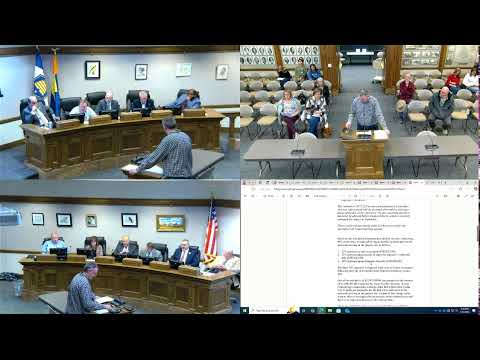
Cedar City Council approves conditional change order to advance deposit for wastewater filtration amid debate over lead times
Summary
After a lengthy debate about supplier lead times and precedent, the council approved change order #2 to advance contract payments for a wastewater filtration component, subject to state approval and contractual protections to offset the city's financing costs.
Cedar City Council approved a conditional change order on Feb. 12 to advance supplier payments for a wastewater filtration component after extended debate about long lead times and who should bear financing risk.
City engineer Jonathan Stathis told the council that approval of change order #2 would be contingent upon the Utah Division of Water Quality also signing off. He said the state contribution to the project totals about $2,100,000 and the full project cost is roughly $4,600,000, meaning state funding would cover a little less than half of the total project cost.
Council debate focused on a supplier request for large upfront deposits because of long manufacturing lead times. Councilman Melling moved to approve the change order as an advance to the contractor that would (1) authorize the first 25% payment to execute the order, (2) authorize a second 25% payment after the approved engineer submittal data is completed, (3) preserve all bonding and liability provisions with the contractor, and (4) require the contractor to reduce the contract price by the city27s average Public Treasurer27s Investment Fund (PTIF) interest earned on the advanced funds plus 5% to cover administrative costs. "I would move that we amend the, or we approve the change order number 2, with a number of conditions," Melling said when offering the motion.
Opponents warned about precedent and the city effectively acting as a long-term financier. Councilman Phillips said he would vote no, citing concerns that advancing substantial funds could set the wrong precedent for future contracts and put staff in a difficult position. Phillips said he felt bad for the local contractor but that the city should be cautious about changing standard contracting practice.
Supporters said the payment structure represented a middle ground given limited contractor interest, long mobilization costs and supply-chain realities. Supporters noted the city could limit the amount advanced, keep contractual protections intact and require reimbursement or a contract-price reduction to offset lost interest. The motion passed after recorded votes (see "Actions" section). City staff said the Division of Water Quality must also approve the change order before reimbursement or payment sequencing would be finalized.
The council instructed staff to spell out contractual language that (a) confirms the city is advancing funds to the contractor (not to the supplier directly), (b) preserves the contractor27s bonding and liability, and (c) sets the mechanism for offsetting the city27s finance cost through a contract reduction tied to the PTIF rate plus an administrative percentage.
The council27s decision allows the wastewater project to move forward while adding explicit safeguards the council sought to limit short-term risk and account for long lead times described by the supplier and contractor.
Next steps: staff will finalize the change-order language, secure Division of Water Quality approval and process the advance payments per the motion if state sign-off is obtained.