Get Full Government Meeting Transcripts, Videos, & Alerts Forever!
Get email alerts on the Land Use topic
No spam. Unsubscribe anytime.
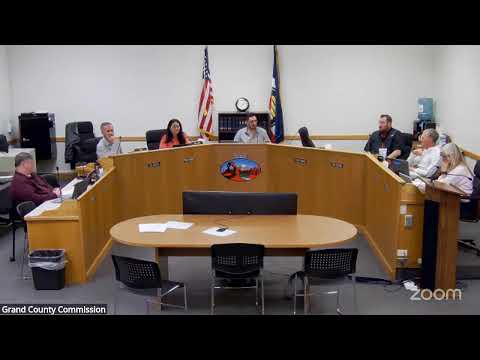
Ombudsman trains Grand County commissioners on conditional use permits and the need to —show your work—
Summary
Jordan Collemore of the Utah Ombudsman's Office led a workshop explaining why conditional use permits are administrative decisions that must be supported by substantial evidence, how to craft objective standards and conditions, and why clear factual findings in the record are essential to withstand legal challenge.
Jordan Collemore, lead attorney at the Utah Ombudsman's Office, led a training for Grand County commissioners on the legal standards that govern conditional use permits (CUPs), emphasizing the difference between legislative and administrative land-use decisions and the evidentiary burden that applies when the county acts as the land-use authority.
Collemore told commissioners that CUPs are administrative applications and therefore ‘‘you're not deciding what you want the rules to be'' but rather must apply existing code standards to the facts before you. He repeatedly urged officials to —show your work— by recording factual findings, expert studies and the specific conditions imposed so that a decision is supported by substantial evidence and can survive judicial review. Collemore cited McElhinney v. Moab City (Utah Court of Appeals) as an example in which inadequate findings led a court to overturn a denial.
Commissioners and staff asked how to handle late-changing safety concerns raised during public comment. Collemore and staff advised that individual preferences are not a substitute for expert evidence in an administrative decision; if safety materially changes, the correct remedies are either imposition of tailored conditions or amendment of the land-use code for future applications. Staff reminded the commission that under current local code the commission is the land-use authority for CUPs, though many jurisdictions delegate CUP decisions to planning commissions or zoning administrators.
The workshop covered practical steps: identify —reasonably anticipated detrimental effects— under code criteria, require traffic or engineering studies when necessary, impose reasonable, objective conditions tied to those standards, and make detailed findings of fact and conclusions of law in the record. Collemore warned that overly broad or vague standards invite claims of arbitrary discretion. He recommended leaning on staff, the county attorney and technical experts to build a defensible record.