Get Full Government Meeting Transcripts, Videos, & Alerts Forever!
Get email alerts on the Economic Development topic
No spam. Unsubscribe anytime.
Bloomington council backs regional study to explore Economic Development District with Brown and Owen counties
Summary
The Bloomington Common Council voted unanimously Aug. 21 to authorize distribution of a letter to the U.S. Economic Development Administration backing a comprehensive economic development strategy (SEDS) and exploring an Economic Development District designation with Brown and Owen counties. Council members stressed that the vote approves only the exploratory step, not final designation.
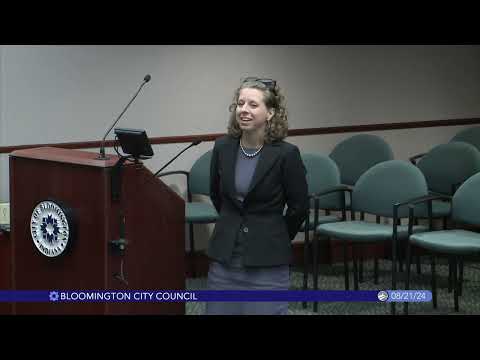
The Bloomington Common Council voted 7–0 Aug. 21 to authorize a letter to the U.S. Economic Development Administration supporting a comprehensive economic development strategy (SEDS) and the potential formation of an Economic Development District (EDD) with Brown and Owen counties.
Council member Asari introduced the memo and motion, saying the step is meant to ‘‘start the processes of working towards a economic development district’’ and to allow the region to pursue federal funding opportunities tied to a SEDS. Jen Pearl, president of the Bloomington Economic Development Corporation, told the council that the SEDS is a consultative, multi-step planning process that can unlock access to federal programs and that costs are generally shared among partners and supplemented by public and private sources.
Why it matters: Council members emphasized that this motion authorizes only the exploratory SEDS phase and does not commit Bloomington to any final designation or long-term costs. Members pressed for clarity about fiscal impacts and measurements of success; supporters said those details are defined through the SEDS process itself, including community-driven metrics and a SWOT analysis.
Discussion and key points: Council member Stossberg asked whether the fiscal impact applies to the study or to a later stage; Asari and Pearl said SEDS costs can be modestly funded through the EDA (the EDA’s application can cover up to about $50,000) but practical consultant costs for a robust SEDS often approach six figures, which would likely be split among regional partners. Pearl said public and private funds would be sought rather than relying solely on one government unit.
Council member Alo pressed how success would be measured; Pearl said the SEDS process establishes community-defined metrics during the strategy exercise. Council member Olive urged that equity and environmental impacts be defined and tracked rather than treating ‘‘growth’’ as a single metric. Multiple council members said the SEDS stage is an opportunity to ask those questions collectively.
Public input: The council offered a brief public‑comment period on the item; no members of the public signed up to speak during that segment. During the general public-comment period, resident Greg Alexander urged the council to prioritize active-transportation projects, noting decades of delay for a safe connection to North High School identified in an earlier plan.
Next steps: The chair signed the letter on behalf of the council and staff will forward it to the EDA. Council members requested follow-up briefings and additional documentation on anticipated costs, potential interlocal agreements for cost sharing among Monroe, Brown and Owen counties, and defined SEDS metrics.
(Reporting note: The council clarified that the vote authorizes distribution of a letter of support to initiate the SEDS process; any later step toward formal EDD designation would return to the council for further action.)