Get Full Government Meeting Transcripts, Videos, & Alerts Forever!
Get email alerts on the Homelessness Restrooms Udo topic
No spam. Unsubscribe anytime.
Bloomington council and residents push short-term restroom access and UDO changes to address street homelessness
Summary
At a Sept. 11 Bloomington Common Council session, members and community participants pressed for immediate restroom access solutions and discussed long-term zoning changes to allow single-room-occupancy housing and revise the UDO definition of "family." Council will compile notes and explore next steps with the mayor's office.
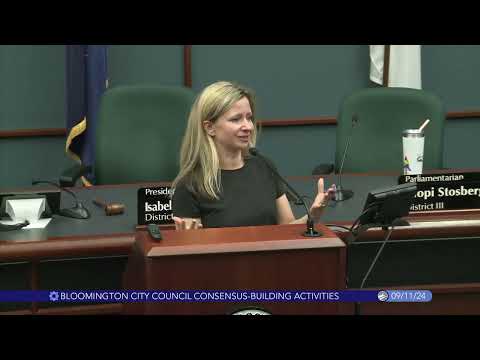
The Bloomington Common Council on Sept. 11 held a public deliberation focused on street homelessness, with members and residents discussing immediate restroom access and longer-term revisions to the Unified Development Ordinance to expand affordable housing options.
Council Member Daley outlined short-term options that emerged from an Aug. 14 consensus session, including adding portable toilets at parks, evaluating existing park and parking-garage restrooms (some seasonal), and possibly extending security hours. Daley said vandalism is the primary barrier to keeping restrooms open and added, "This is not something that the city council actually can do. We don't have the authority to to keep restrooms open or to add more portelets," while noting the mayor's office has been open to discussions on possible steps.
Council Member Sydney Zulick (District 6) presented two long-term UDO approaches: permitting more single-room-occupancy (SRO) buildings as lower-cost rental options, and revising the UDO's definition of "family." Zulick explained SROs as units where rooms are rented separately and shared common areas exist, and said they "could be a low cost option for individuals or couples being diverted from homelessness or moving out of homelessness." On the family definition, Zulick offered specific options discussed with participants: remove the current "under 55" exception; raise the maximum number of unrelated people allowed in a unit to four or five; or base allowable occupancy on the number of bedrooms rather than a flat cap on unrelated individuals.
Zulick cautioned about potential drawbacks, including whether SROs would blend into certain neighborhoods, increased noise and limited parking. She noted that choices on zoning districts and size will affect neighborhood fit. Daley and others said the council will support and track these ideas, but that some short-term measures—such as keeping restrooms open at parks—may require executive-branch or operational changes beyond the council's direct authority.
Facilitators from the Community Justice and Mediation Center took notes during small-group deliberations and will deliver a compiled record to the council. The council said notes from the Aug. 14 session and tonight's deliberation will be posted on the council website's meetings link and made available to participants who provided email addresses. The council indicated it will consider moving forward with one or both UDO changes and continue collaboration with the mayor's office to pursue short-term restroom access solutions.
The session proceeded to breakout groups for focused discussion and returned for a large-group debrief; no formal motions or votes were taken. The council plans to review the compiled notes and determine next procedural steps.