Get Full Government Meeting Transcripts, Videos, & Alerts Forever!
Get email alerts on the Homelessness Funding topic
No spam. Unsubscribe anytime.
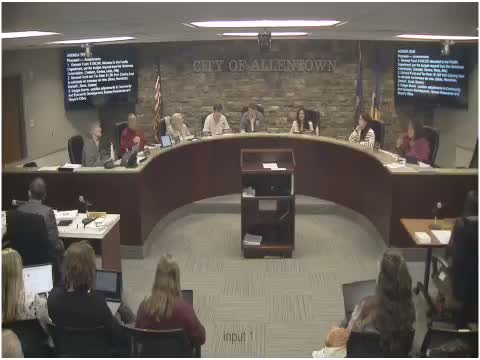
Council allocates $100,000 to homelessness response line items after commission testimony
Summary
Council specified $100,000 in the budget for short-term homelessness response (hotel stays, portable sanitation, laundry, pet boarding and gift-card compensation) after testimony by the Commission on Homelessness and local providers; the funding source and fund mechanics were clarified on the record.
The Allentown City Council voted to specify $100,000 in the budget for targeted homelessness response items after hearing testimony from the Commission on Homelessness and community providers.
Council member Gerlach proposed the amendment to detail how $100,000 would be spent across a set of line items recommended by the commission: hotel funding for imminent-risk households, portable restrooms and hand-washing/hydration stations, gift-card compensation for people with lived experience who assist outreach, laundry resources, and animal-care/boarding assistance to remove a barrier to shelter and treatment.
Christine, co-chair of the Commission on Homelessness, told council the items were developed over five months with input from outreach workers and providers and described the proposal as a short-term but deliberate 'continuum-of-care' approach. "We're not asking the city to be the case managers, but these items are needed to get people linked up to proper housing or safe housing," she said in testimony.
Community provider Jackie Howells, director of Loads of Blessings laundry ministry, described the program's role as a service hub and offered usage figures: her program served 81 families at a recent session and spent approximately $877 that day on wash-and-dry costs. She told council that laundry services build trust and help people access medical and recovery services.
Council and administration staff discussed whether the $100,000 already appears in enterprise funds (building code/CED) and the practical limits of using enterprise fund dollars for hotel contracts. Budget staff and the administration explained that placing money in the health department's 46 account would allow the city to subcontract services and reimburse community agencies for hotel stays and other services.
The council approved specifying the $100,000 and directing it to the unhoused coordination services budget to be administered by the unhoused services coordinator, with administration oversight for contracting and invoicing. On the record, staff noted that existing enterprise-fund dollars for emergent displacement cover part of the need but cannot directly be used in some contracting arrangements without adjustments.
What happens next: Administration staff and the unhoused services coordinator will establish contracting mechanisms and invoicing standards, and the council will monitor implementation. The allocation is structured as one-time funding for targeted services and does not constitute a permanent programmatic entitlement.