Get Full Government Meeting Transcripts, Videos, & Alerts Forever!
Get email alerts on the Residential Rebuild topic
No spam. Unsubscribe anytime.
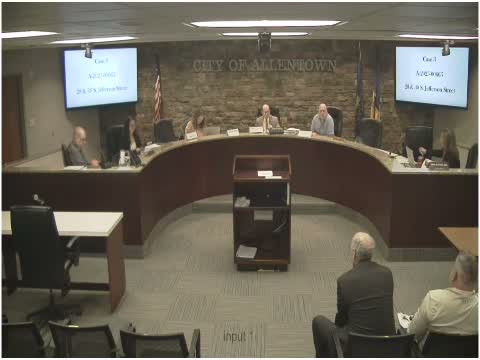
Zoning board allows rebuilt 28 & 30 South Jefferson to proceed as two‑family units with parking conditions
Summary
After lengthy debate about nonconforming‑lot rules and precedent, the board concluded post‑fire reconstruction at 28 and 30 South Jefferson may proceed as permitted two‑family development under §13‑29.05, subject to on‑site and leased off‑site parking and new building permits.
The Allentown Zoning Hearing Board on Dec. 1 ruled that two fire‑damaged properties at 28 and 30 South Jefferson may be rebuilt and used as two‑family dwellings under the city’s nonconforming‑lot provisions, but the board imposed parking and permitting conditions.
Attorney (Mister Fogarty) and owner Thomas Williams presented evidence that the properties suffered extensive fire damage about a year earlier and that much of the interior was demolished; they submitted tax records, site photos, renderings and building permit files. Williams said the exterior facades have been restored in part and the project team had arranged up to six leased spaces at a nearby church to help meet parking needs.
Board and staff review showed differing building permits on file: for 28 South Jefferson a reconstruction permit was on record (noted as on hold), and for 30 South Jefferson the file showed framing‑repair work and a stop‑work notation pending zoning review. Members debated whether the work constituted a "residential conversion" (which carries different standards) or a rebuilt permitted use. Counsel for the applicants argued that because the lots predate the ordinance and no active residential use existed after the fire, Section 13‑29.05 allows putting nonconforming lots to any use allowed in the district.
Board members raised concerns about precedent and an increase in neighborhood density if damaged single‑family houses could be routinely rebuilt as multiple units. A majority cited the plain language of §13‑29.05 and the applicants’ evidence and concluded that, for these properties, the ordinance excused certain dimensional requirements and permitted a two‑family use. The board specifically required on‑site parking and off‑site mitigation: one on‑site space per lot plus arrangements bringing the total to eight parking spaces (three on‑site total and six leased off‑site), and also required that the applicants submit new or updated building permit applications and comply with applicable codes.
The motion carried by voice vote. Board members noted the city administration and building department retain authority to review permit details and to assess whether a future subtenant or altered use conforms to zoning. Several members emphasized the decision was fact‑specific and that the city could address any broader policy concerns through ordinance amendments.
Why it matters: the ruling allows the property owner to move forward with rebuilding efforts that could increase local housing supply but also changes parking and density considerations on a residential block.