Get Full Government Meeting Transcripts, Videos, & Alerts Forever!
Get email alerts on the Budget Process topic
No spam. Unsubscribe anytime.
Allentown committee weighs new revenue ideas, amid limits imposed by NIZ and charter rules
Summary
Committee members asked for a standing review of the budget process and a task group to explore revenue options — including entertainment taxes, impact fees, recycling revenue and rebates — while finance staff warned that the Neighborhood Improvement Zone (NIZ) and home-rule limits constrain some options.
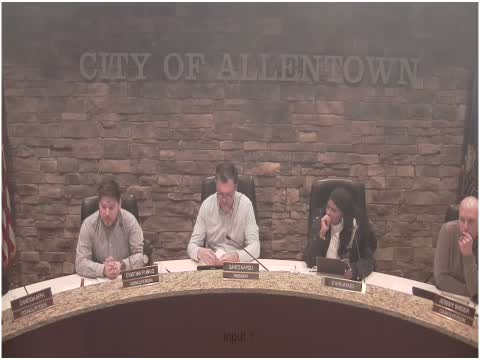
Committee members at the Jan. 23 Allentown Budget & Finance meeting pressed administration staff to explore additional revenue sources and to increase council–administration collaboration earlier in the budget cycle.
Miss Patel reviewed the seven-month budget calendar and said the key window for council input is mid-August through early September, when departments’ budget submissions are analyzed and the administration still has time to incorporate priorities into the proposed budget. She said this cycle began with a general-fund gap of about $15 million that the budget team worked through to present a balanced proposal.
Several council members recommended forming a committee or focused working group to study alternatives to broad property-tax increases. Suggestions included entertainment or amusement taxes, reviewing impact fees allowed under the municipal planning code, renegotiating large contracts (including arrangements tied to venues such as the PPL Center) and looking for revenue from recycling contracts. Miss Patel said some options are limited by the home-rule charter and existing legislation but welcomed the committee idea.
Councilmember(s) argued that municipalities such as Easton and Bethlehem levy entertainment fees and impact fees and that Allentown should examine whether similar approaches could be feasible locally. One speaker urged a differentiated approach — for example, rebates targeted by income bracket rather than only age or disability — and asked whether the city could partner with community organizations or the county to reduce administrative burden on the city. Miss Patel said staff had engaged the county while evaluating rebate-threshold changes but did not receive the information needed; she said verification of household income is administratively difficult when deeds list a single owner with multiple wage earners present.
Committee members also discussed the Neighborhood Improvement Zone (NIZ). A council member pointed out tradeoffs tied to the NIZ: though the city foregoes some event- and earned-income-tax receipts in the NIZ, redevelopment has yielded substantially higher property-tax revenue in redeveloped parcels. That speaker cautioned that changing NIZ arrangements could risk disrupting long-term redevelopment gains.
Miss Patel described a prior ordinance (listed in the transcript as Ord. 160887) that reduced a 10% late-payment penalty on property taxes to 5%, which she said benefited about 2,800 property owners and cost the city roughly $95,500 in foregone penalties; the rebate program’s applications reportedly rose from 36 in 2024 to 81 in 2025. Committee members asked administration to consider outreach to increase uptake of rebate programs and to explore partnerships to limit administrative overhead.
No formal votes or ordinance actions were taken; members asked for follow-up analysis and scheduled further meetings to examine other municipalities’ processes and to define a potential working group’s scope. The committee also requested that the administration provide a commercial/residential breakdown of building-code revenues and additional detail about contract services in the proposed budget so council can review nonpersonnel costs during budget time rather than solely at contract approval.
The committee adjourned after the controller, Mr. Glaser, and finance staff offered support for continuing the review of the budget process and next steps for collaboration.