Get Full Government Meeting Transcripts, Videos, & Alerts Forever!
Get email alerts on the Quality Of Life Task Force topic
No spam. Unsubscribe anytime.
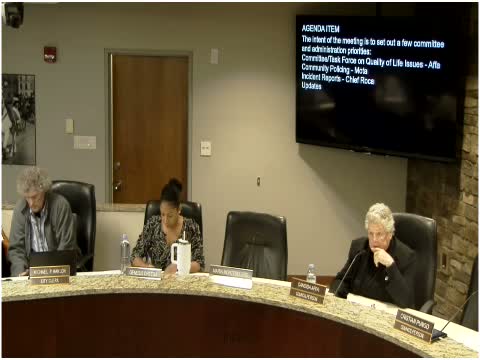
Allentown councilmember announces Quality of Life task force; police chief unveils data dashboard plans
Summary
A councilmember announced a Quality of Life task force to tackle noise, dumping and other neighborhood nuisances while the police chief said an incident dashboard and a council-specific report will track quality-of-life incidents and recent crime trends.
A councilmember announced plans to form a Quality of Life task force that will work with the police chief, city staff and selected residents to address recurring neighborhood nuisances such as loud vehicles, illegal dumping, garbage and dog waste.
The announcement came at the start of the meeting, when the councilmember said the task force would include city staff (including nuisance-abatement officers and public works), a solicitor to advise on legal options, and about four citizen representatives drawn from different parts of Allentown. "I want this force, this task force to solve the problems," the councilmember said, emphasizing that the group should propose practical solutions rather than act as a forum for complaints.
Chief of Police (name not specified) pledged the department's support and previewed a new incident dashboard and a council-specific report that he said will show the types of quality-of-life incidents the department is seeing. "Expect that within the next week that you should have" a report for council review, the chief said, adding the department is finalizing year-end statistics.
The chief reported that, for 2025, "violent crime was down, 2.36 points from 2024" and that "property crime is down 132.15 points, from 2024," and said addressing quality-of-life issues will require cross-department collaboration and public engagement. He said the dashboard will be designed for public review once the department and council finalize how data will be distributed.
Council members and others raised questions about how the dashboard will categorize calls — particularly mental-health-related responses — and whether older CIS (computerized information system) data will be integrated. One councilmember asked whether the dashboard will distinguish welfare checks from mental-health calls and requested that categorizations be presented in lay terms. The chief said the department will meet in February to finalize distribution and presentation details and to produce a user-friendly product for council and the public.
Members urged recruiting residents from across neighborhoods — including the West Side and Center City — and cautioned that the task force should begin by understanding existing ordinances and legal constraints. Speaker 6 suggested adding more Center City residents because of higher density and more reported incidents. The councilmember said the solicitor's presence at task-force meetings will help identify what the city can legally accomplish and avoid measures that could be seen as overly punitive.
No formal motion or vote to create the task force was recorded in the meeting; the announcement appears to be an administrative direction and an invitation to interested residents. The councilmember said she will confirm citizen appointees and notify council when membership is finalized.
What happens next: council members said they expect the police report and incident dashboard to be presented to council once the department has finalized the interface and data categories; recruitment and the task force's first meeting schedule were described as forthcoming.