Get Full Government Meeting Transcripts, Videos, & Alerts Forever!
Get email alerts on the Policy 2 3 Entitlements topic
No spam. Unsubscribe anytime.
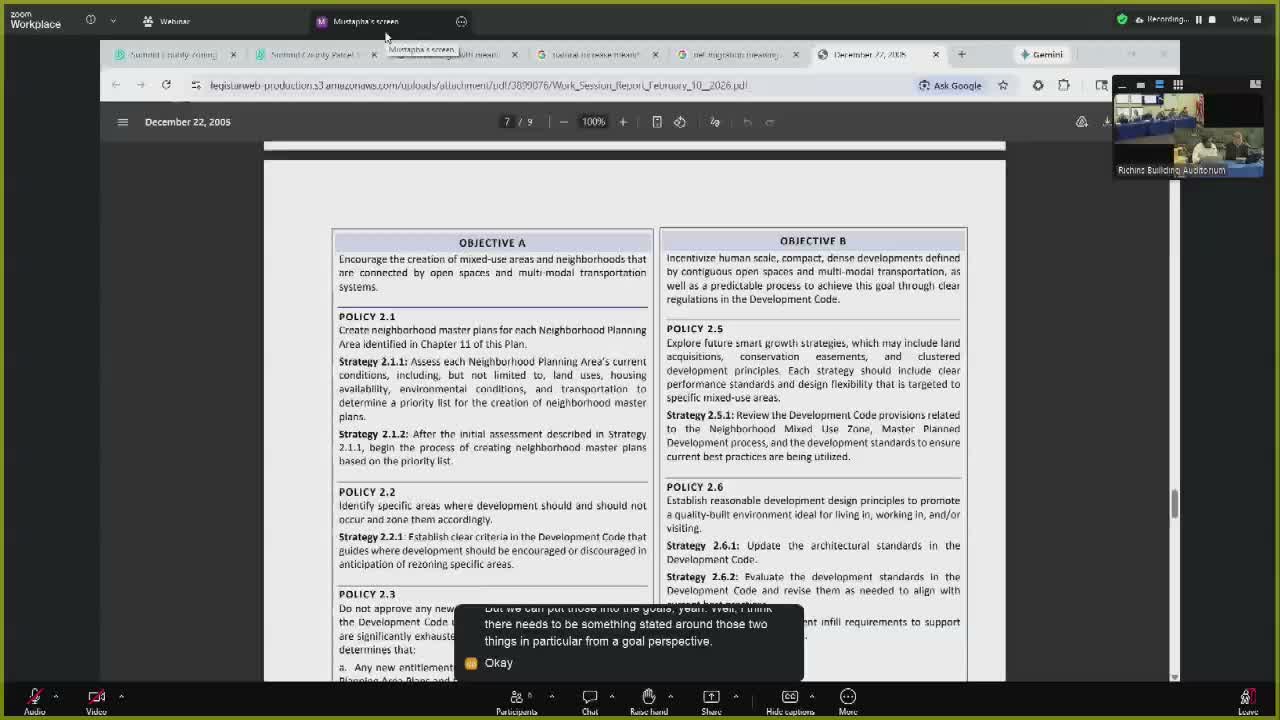
Commissioners press staff to clarify Policy 2.3 on new entitlements, request overlays showing vested agreements
Summary
After staff outlined land‑use goals and maps, commissioners questioned how the future land‑use vision reconciles with vested development agreements and debated whether Policy 2.3 (limit on new entitlements) should be kept, softened or reframed; staff agreed to produce redlines and overlay GIS maps and return with alternatives.
Commission discussion pivoted from the chapter presentations to a sustained debate over how the draft plan treats existing entitlements, vested development agreements and where the county wants future density.
Multiple commissioners said the presented map set was difficult to interpret and urged staff to produce layered overlays that show current zoning, the boundaries of settlement/development agreements, deeded open space and parcel‑level entitlement status. As one commissioner summarized, “If you really wanna create... a place that people wanna live that they can identify as their town, I think we need to think about that concept somehow,” and asked staff to show “what's left” to achieve the vision.
Policy 2.3 — language included in the existing general plan that has been used to deny new entitlements until existing entitlements are substantially exhausted — prompted the strongest debate. Staff described Policy 2.3 as a tool adopted in the early 2000s to limit approvals while existing entitlements were built out and said it has been used several times to deny projects. One commissioner framed the policy as a negative lever that “ties the hands” of the county council and recommended positive, place‑based language identifying where new entitlements should be encouraged. Another commissioner argued the policy should remain because it provides a necessary check that allows the commission and council to refuse new entitlements when appropriate. The commission asked staff to draft softened or alternative wording for 2.3 for future review.
Staff also warned that state legislation could limit local discretion. Speaking about bills under consideration, staff said a proposed law (described in the meeting as SB 184) would allow a developer to notify the county of an intended development and require the county to confirm within a short window whether state affordable‑housing criteria are met; “and then the density is granted,” staff said, adding that the county is monitoring legislation closely.
Commissioners discussed implementation mechanisms. Staff pointed to the SPA (specially planned area) process and incentive density provisions that have historically been instruments to negotiate public benefits and preserve open space; Commissioner S8 read code section language (cited in meeting as 10‑44) requiring conservation easements when incentive density is granted. Commissioners used Lincoln Station (rezoned and approved with an affordable housing finding) as an example where the county council made a specific finding to allow a new entitlement.
Next steps recorded in the meeting: staff agreed to prepare redlined alternatives for Policy 2.3, create GIS overlays reconciling zoning with vested agreements and entitled/undeveloped parcels, circulate edits in advance of the next work session and return to the commission for further review. Commissioners also discussed shifting light agendas to a 6 p.m. start to facilitate attendance.
Votes at a glance: the commission approved minutes for 11/25/2025 and 01/13/2026 by voice vote; minutes for 01/27/2026 were approved with two abstentions recorded.