Get Full Government Meeting Transcripts, Videos, & Alerts Forever!
Get email alerts on the Public Procurement topic
No spam. Unsubscribe anytime.
Developer urges council to overturn bid decision on Springtown golf course contract
Summary
A Schrader & Brandt representative asked the Livermore City Council to pull and reconsider item 5.8, arguing the apparent low bidder ($5,386,000) had minor, waivable deviations and that accepting a second-low bid would cost the city roughly $287,000.
Brian Bertoza, representing Schrader & Brandt, asked the council to pull item 5.8 from the consent calendar and reconsider the apparent low bid for the Springtown Community golf course project. He said Schrader & Brandt was the low bidder at $5,386,000 and that the next low bid was about $287,000 higher. Bertoza argued the deviations staff identified (a single corporate signature where two were requested and an initial omission of subcontractor percentage totals) were inconsequential and waivable under California case law.
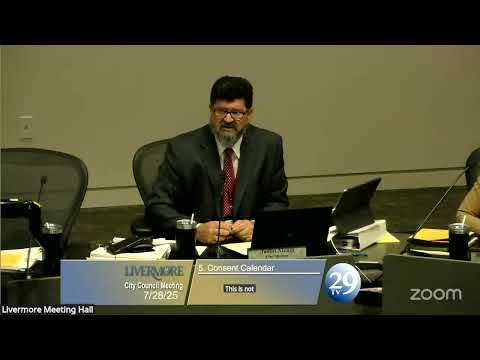
City Attorney Jace Stockhola explained the governing legal framework for public contracts, saying staff must evaluate whether a bid is responsive and that staff had determined Schrader’s bid was nonresponsive because of defects that staff found created a potential disadvantage. "Staff made the determination that their bid was nonresponsive, and they also made the determination that the errors were not inconsequential," Stockhola said.
Bertoza urged the council to exercise discretion and save taxpayers the $287,000 difference by proceeding with the apparently lower bid if council concluded the deviations were waivable. The council discussed the legal distinction between staff-level responsiveness findings and council-level responsibility determinations; Mayor Marchand emphasized responsiveness findings are typically an administrative staff decision.
Council ultimately approved the consent calendar with an abstention recorded on item 5.8 (Mayor Marchand abstained). The council did not vote to overturn staff’s responsiveness determination in this meeting; staff's procurement findings remain the stated basis for the award process unless council directs otherwise in a future action.
Next steps: Item 5.8 remains subject to staff’s responsiveness determination and any further council direction if members choose to bring a separate motion to reconsider the award.