Get Full Government Meeting Transcripts, Videos, & Alerts Forever!
Get email alerts on the Ordinance 17 96 topic
No spam. Unsubscribe anytime.
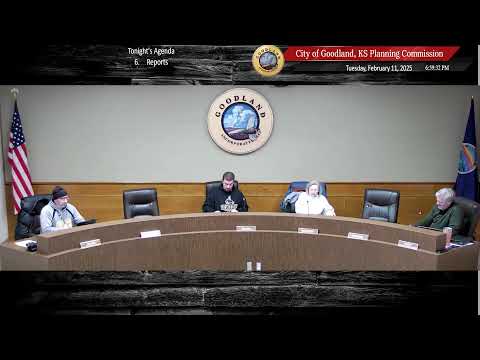
Planning commission continues review of adult‑entertainment zoning, sets March public hearing and requests licensing proposal
Summary
Commissioners reviewed proposed Ordinance 17‑96 to restrict adult entertainment establishments to C1 zoning as a conditional use, debated a 1,000‑foot setback and administrative licensing, and agreed to set a public hearing in March while staff refines licensing language for a later recommendation to the City Commission.
The Goodland Planning Commission spent extensive time reviewing Ordinance 17‑96, which would change municipal code language from 'adult entertainment facility' to 'adult entertainment establishment,' update the use table and allow such uses only in C1 districts as a conditional use subject to enumerated restrictions.
Staff read the proposed amendments, noting the draft includes a prohibition that "no adult entertainment establishment may be located within 1,000 feet" of specified uses such as daycare, school, park, playground, church or the boundary of a residential district. Commissioners flagged an inconsistency in the materials — some packet pages referenced 500 feet — and asked staff to clarify the correct distance in the ordinance text and packet prior to formal action.
Commission members asked staff to map the proposed restrictions because, as drafted, the 1,000‑foot buffer could exclude much of the commercially zoned corridors (for example along Highway 24 and K‑27 and areas north of the railroad tracks), leaving few locations where such a use would be allowed. Staff agreed to produce clear maps showing where the ordinance would permit adult‑entertainment establishments.
The commission also debated whether to handle operational rules through zoning (which requires a public hearing) or a parallel licensing regime (administrative), citing examples from 12 other communities. Commissioners expressed concerns about possible administrative burdens — for example, requiring every clerk or server to hold a license — and discussed targeted approaches such as manager licensing, inspection authority, and suspension/revocation procedures. Several commissioners said they favored clear, administratively determinable criteria so decisions are not treated as political judgments.
Commissioners asked staff to consult legal counsel on outstanding questions and agreed to set a public hearing at the March meeting for the ordinance amendments; they asked staff to continue drafting a licensing recommendation so the Planning Commission could present both zoning changes and licensing guidance to the City Commission together. Staff noted that while the licensing portion does not require a public hearing, the zoning text does. The commission did not take a final vote on the ordinance at this meeting.