Researcher reports low false‑positive rates for duct‑tape fracture matches, but manipulation raises false negatives
Get AI-powered insights, summaries, and transcripts
SubscribeSummary
At a symposium, Dr. Tatiana Trejos presented a laboratory study of duct‑tape fracture matches showing very low false‑positive rates in controlled samples and about 98% true‑positive performance, but she reported false‑negative rates can rise to roughly 64% after extreme physical manipulation; she called for interlaboratory collaboration to validate scoring thresholds.
Dr. Tatiana Trejos presented results at the symposium from a laboratory study that evaluated error rates in fracture‑match examinations of duct tape and proposed a discrete, scrim‑area scoring method intended to improve consistency among examiners.
Trejos, the study’s lead presenter, said forensic tape comparisons commonly support criminal and national‑security investigations, but that ‘‘there are no standardized criteria to arrive to a conclusion of a fracture match,’’ which leaves determinations dependent on examiner judgment. The project’s goal, she said, is to develop standardized match/nonmatch thresholds and measure their accuracy.
The study began with one roll of tape cut into 250 samples (about half hand‑torn and half scissor‑cut). The team generated random pairings and ran roughly 2,000 comparison tasks across training and test sets. Trejos described a blinding procedure in which an analyst unassociated with the examinations removed original labels and relabeled pieces so examiners could not infer pairings.
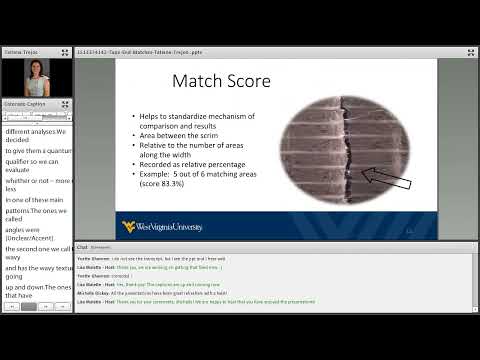
Analysts recorded physical features and fracture characteristics for each discrete comparison unit and reported a 0–100% match score, then used categorical qualifiers such as ‘‘strong match,’’ ‘‘weak match,’’ ‘‘inconclusive’’ and ‘‘nonmatch.’’ To improve consistency, Trejos said the team scored the smaller unit represented by areas between scrim/screen fibers and then calculated the percent of those discrete areas that matched (for example, 5 of 6 matching areas = 83%).
In pristine hand‑torn nonmatch sets the analysts reported zero false positives in the dataset (reported as 0 of 409 nonmatch comparisons). Trejos said workshop statisticians recommended applying the ‘‘rule of three’’ to estimate an upper bound for an observed zero, which would produce an approximate upper 95% bound of 3/409, or about 0.7 percent. For true‑match sets the team observed two false negatives across analysts, giving roughly 98 percent true‑positive performance on the tested set.
Trejos said scissor‑cut samples produced similar accuracy and a clear separation of true positives and true negatives when using the score metric. However, the study’s manipulation experiments — described as ‘‘mid’’ and ‘‘high’’ manipulation where samples were repeatedly flipped, stretched or aggressively rejoined and separated — reduced the separation between match and nonmatch distributions and increased false negatives. Under the most extreme manipulations Trejos reported false‑negative rates rising up to about 64 percent, while false positives remained rare in these tests.
Trejos argued that a scrim‑area match score both improves inter‑analyst agreement and enables statistical analysis such as ROC curves and likelihood ratios to quantify decision risk. ‘‘With that information having a score match, you can see the distribution of the true positives represented … and the true negatives,’’ she said during the presentation.
She concluded that false‑negative rates are low in pristine samples (on the order of 1–2 percent in her reported sets) but increase with physical manipulation of the tape edges, which can obscure discriminating fracture characteristics. Trejos said the score approach shows promise but must be tested with practicing examiners in interlaboratory trials before it can be recommended as a standard.
Trejos thanked colleagues Aaron Brake and Corinna Menkin Hogat for assistance with relabeling and manipulation and named the West Virginia Research College Fund as a source of funding for the work. She invited practitioners and laboratories interested in collaborating on an interlaboratory study to contact her.
The presentation ended with an audience invitation for questions and the moderator closed the afternoon session and announced a book signing and the keynote location.