
Portable GC‑MS with SPME identified common ignitable liquids on scene, expert reports
Get AI-powered insights, summaries, and transcripts
Subscribe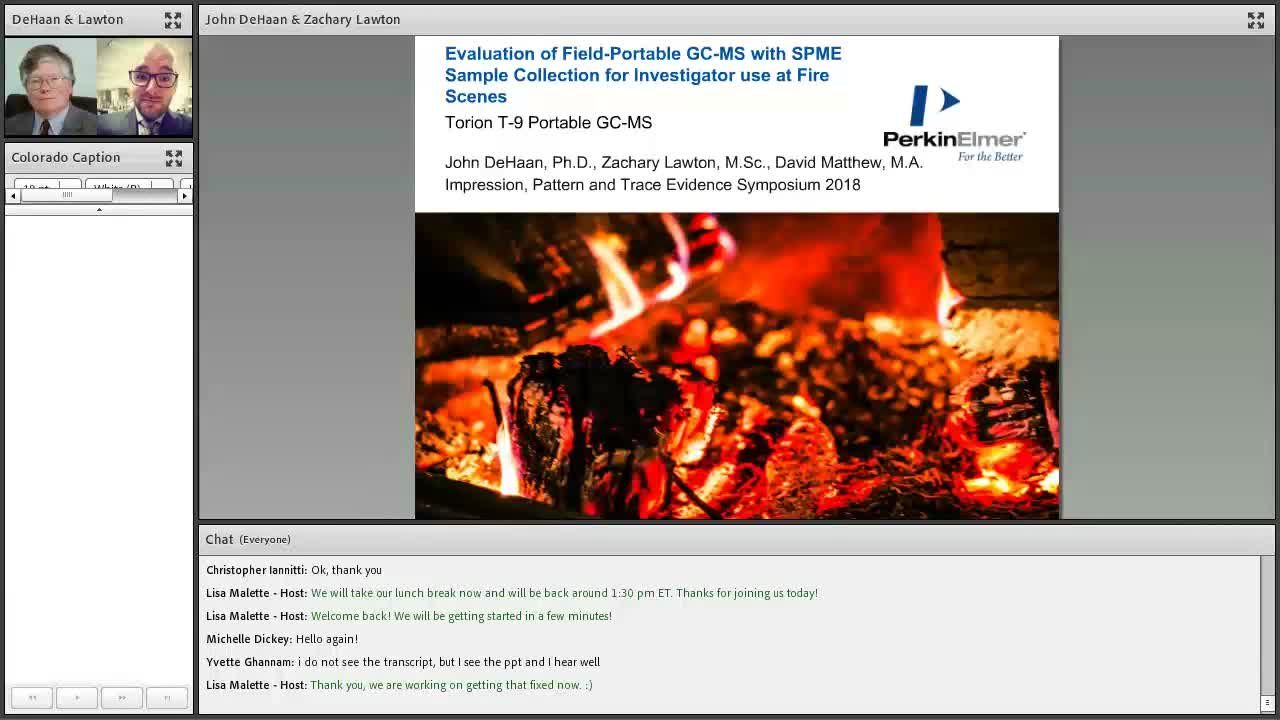
Summary
Dr. John DeHaan presented test results showing portable gas chromatography–mass spectrometry (GC‑MS) with SPME sampling can detect common ignitable liquids — including gasoline, diesel, E85 and kerosene — in as little as three minutes and correlate closely with laboratory GC‑MS results, though limitations remain.
Dr. John DeHaan, a fire and explosion forensic scientist with more than 45 years of experience, told attendees his team’s tests show portable gas chromatography–mass spectrometry (GC‑MS) using solid‑phase microextraction (SPME) can produce field identifications of common ignitable liquids and closely match laboratory results.
"In three minutes, you get GC data," DeHaan said, describing the system’s quick run time and the device’s capability to generate mass spectra on‑scene. He said the setup produced identifiable traces of diesel fuel, 87‑octane gasoline, E85 and kerosene even after intense, post‑flashover burns in controlled test rooms at Sam Houston State University.
The tests began as bench‑scale experiments and expanded to furnished‑room burns. DeHaan described a simple sampling modification — a small cup placed over the sample that he called a practical field fix — that traps vapors and reduces drafts. "After 47 years, what am I gonna be noted for as a scientist was a Dixie cup with a hole in it, but it works," he said.
DeHaan outlined the portable instrument’s key features: a 5‑meter polar column with rapid temperature programming, a toroidal ion trap that runs on a rechargeable battery (about 2½ hours), and disposable helium canisters, making the unit self‑contained and more robust for field conditions than earlier lab‑style machines. The team also tied the instrument output to a curated National Institute of Standards and Technology (NIST) spectral library to improve automated identifications.
To validate field results, the group collected SPME samples on‑scene, sealed debris in standard evidence cans, and sent them to fixed forensic laboratories. DeHaan reported a strong correlation between portable system readings and subsequent laboratory GC‑MS analyses provided by partner laboratories, including results relayed back from a private lab used by a Louisiana‑based investigation firm and a lab in Georgia.
He described the analytical diagnostics the portable system can produce: carbon number patterns in the C8–C20 range, total ion chromatograms that show aromatic and aliphatic distributions, and identifiable marker peaks sufficient to classify light, medium and heavy petroleum distillates. "We can identify ignitable liquids post‑flashover under field conditions, low part‑per‑billion levels, with the SPME sampling," DeHaan said.
DeHaan also noted limits and operational considerations. The SPME fiber is delicate and has a finite absorptive capacity; sampling times must be tailored to vapor concentration as indicated by a portable PID/sniffer. Ambient temperature affects sensitivity, and the team is not yet ready to replace canine detection: "Not at this point. We can't," he said. He emphasized that the portable readings are intended to guide investigators and that confirmatory laboratory analysis of collected debris remains part of the protocol.
The team is continuing tests and seeking funding to expand trials and refine procedures. DeHaan said the work could shorten the time investigators wait for actionable analytical guidance at scenes, compared with typical laboratory turnarounds that in some jurisdictions can run months.
The presentation included collaborators named during the talk: coauthor Zachary Lawton and sampler Eric Dobson (formerly with Smith's Instruments), and referenced testing assistance at Sam Houston State University and laboratory comparisons involving firms in Louisiana and Georgia. DeHaan said the group is pursuing funding to support further validation and operational deployment.