Researchers demonstrate Raman plus paper-spray mass spectrometry for rapid, corroborating field forensics
Loading...
Summary
A presenter described lab work pairing surface-enhanced Raman spectroscopy with paper-spray mass spectrometry to produce dual, corroborating signatures from a single substrate — an approach meant to speed in‑field identification of drugs, explosives and chemical-agent simulants while addressing laboratory backlogs.
Unidentified Speaker, presenter, described laboratory experiments that paired surface-enhanced Raman spectroscopy with paper-spray mass spectrometry to collect two complementary signatures from a single substrate and argued the approach could make field forensic screening more reliable and faster.
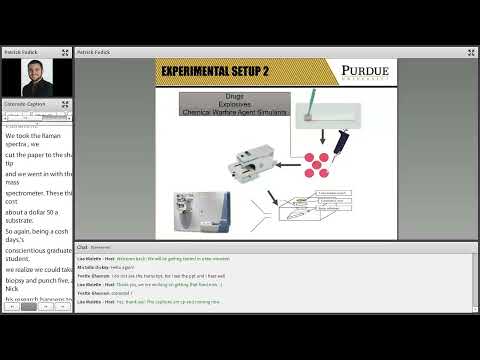
The presenter said the method aims for "minimal to no sample prep" and rapid, in-situ results so law enforcement could get actionable information without the delays of transporting samples to forensic laboratories. He described using inkjet-printed Raman-active paper substrates, collecting a Raman spectrum on a 785‑nanometer instrument, then inserting the same substrate into a paper-spray mass-spectrometry cartridge to obtain MS/MS confirmation. The presenter estimated the substrates cost about $1.50 each and described using a biopsy punch to obtain multiple samples per sheet.
The talk reported that Raman features were detectable in mixtures (for example, heroin cut with fentanyl) and that MS/MS fragmentation patterns remained useful for molecular confirmation. For analytes that fragment poorly on some mass spectrometers — such as RDX, HMX and PETN — the presenter recommended using Raman spectra to corroborate the modest chlorine‑adduct patterns mass spectrometers sometimes produce. He also reported testing a chemical‑warfare simulant (DIMP) and obtaining both Raman bands and MS/MS fragments, which he cited as evidence the two techniques can provide mutually reinforcing confirmation in high‑stakes contexts.
The presenter summarized prior literature showing groups have modified paper substrates to enhance sensitivity, citing teams at Stanford, Ohio State and a collaborator at IUPUI and research from IIT Madras on reactive substrates for explosive detection. He said the combined approach leverages two well‑studied techniques to meet Scientific Working Group drug criteria for multi‑technique confirmation while aiming to reduce sample backlogs.
The researcher noted practical constraints: many ambient ionization methods are fast and inexpensive, but existing validation standards and lab workflows often require a second, different technique for forensic admissibility. That requirement can erode the time savings of a rapid field screen unless validation and operational practices are changed. The presenter suggested building combined spectral databases to support on‑scene identifications and said a next step is to pair portable Raman instruments with portable mass spectrometers for real‑world roadside use.
The presentation closed with funding acknowledgements (the presenter said his lab is funded by DOE and a collaborator’s lab is funded by DOJ) and an invitation for questions.