
Research: Jurors weigh experience and storytelling over raw statistics in forensic testimony
Get AI-powered insights, summaries, and transcripts
Subscribe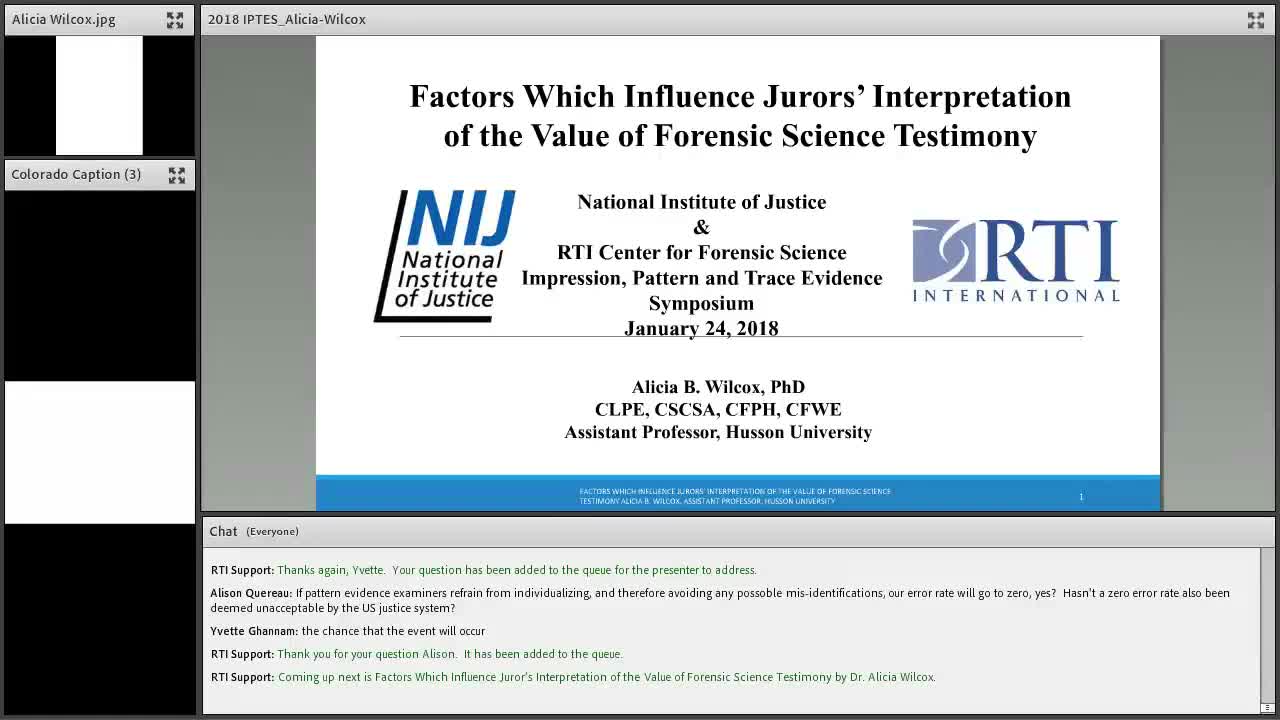
Summary
Alicia Wilcox presented PhD research showing jurors rank years of experience and university education highest for expert credibility, often favor narrative and visual explanations over probabilistic DNA statistics, and view government-called experts as more credible.
Alicia Wilcox, an assistant professor of legal studies at Husson University, presented findings from her PhD research on how jurors evaluate forensic testimony. Wilcox told the audience she studied jurors from nine homicide trials in Maine and combined surveys and phone interviews to learn what shapes juror judgments.
Wilcox said she sent more than 250 paper surveys and received 29 responses; 22 respondents completed phone interviews that ranged from about 35 to 105 minutes. The sample of observed cases consisted of trials in which all defendants were male and all resulted in convictions. "I was a latent print examiner for 10 years with the Maine State Police," Wilcox said, explaining her interest in the topic.
Her survey asked jurors to rank qualifications they valued in expert witnesses. "Jurors rated ... years of experience and education as the most important characteristics of an expert," she said. Wilcox reported an inverse correlation between jurors who prioritized years of experience and those who prioritized formal university education, suggesting jurors favor credentials that mirror their own backgrounds.
Wilcox described three ways jurors process expert testimony: central processing, where jurors engage to understand; peripheral processing, where they rely on cues such as demeanor or attire; and the story model, where jurors fill gaps in the narrative to reach a plausible conclusion. She said jurors often moved from central to peripheral processing when confronted with complex statistics or technical evidence—examples included DNA statistics, cell-tower analysis and some firearms details.
The presentation highlighted discipline-specific perceptions: jurors rated fingerprint and other physical-matching evidence as more reliable than some serology and trace evidence. Wilcox attributed part of the fingerprint credibility to popular-media exposure, noting that a small number of jurors referenced a televised case when discussing fingerprints.
Wilcox reported that 68% of jurors rated forensic science evidence as more important to their decision-making than police or lay witnesses. She emphasized that jurors place extra weight on experts who take time to explain evidence visually and act like teachers, saying such presentation styles often increase perceived reliability even when numerical statistics are strong.
The researcher cautioned against defense stipulations that remove the expert-qualification phase, because jurors use that 5–15 minute period to assess credentials and build credibility. She also noted that being called by a government agency created a perception of vetting: jurors sometimes viewed state-called experts as intrinsically more credible.
Wilcox concluded by calling for foundational validation research in forensic disciplines and suggested that where tasks can be reliably automated, automation should be considered. "We love science, but we love talking and communicating, or we should," she said, arguing that scientists must teach jurors to make complex evidence understandable. The presentation ended with acknowledgments and a question-and-answer period.
The research builds on the 2009 National Academy of Sciences report that called for better study of juror comprehension of forensic evidence; Wilcox said her findings illuminate which aspects of testimony jurors notice and rely on when reaching verdicts.