Get Full Government Meeting Transcripts, Videos, & Alerts Forever!
Get email alerts on the Homelessness topic
No spam. Unsubscribe anytime.
Residents and advocates tell council repeated encampment removals are harming unhoused neighbors; council approves grant support letter
Summary
During two public-comment periods Sept. 4, unhoused residents and advocates described repeated, disruptive evictions and called for safe, stable options; the council approved a letter of support for a Community Foundation grant proposal aimed at homelessness services.
Scores of residents and advocates addressed the Bloomington Common Council on Sept. 4, pressing officials for more immediate, humane options for people living outdoors and criticizing repeated displacement by enforcement.
Speakers described multiple forced moves over days and weeks, lack of storage for belongings, and the difficulty of complying with ordinances that ban camping in public space without alternative shelter. Siddarth Doss, who said he has worked with unhoused neighbors for years, said volunteers have repeatedly helped the same people move "three or four times within the course of a week" and that promised long-term solutions had not materialized. Another speaker, James Bernard, who identified himself as a camp leader, said his family had been forced to move their campsite three times in a month and asked the council to recognize nomadic residents as part of the community.
Advocates repeatedly cited an ordinance number in the discussion of enforcement; President Piedmont Smith clarified in the meeting that Ordinance 2-57 is a county ordinance, not a city ordinance. Speakers urged the council to provide immediate safe places and storage for belongings, not only long-term plans.
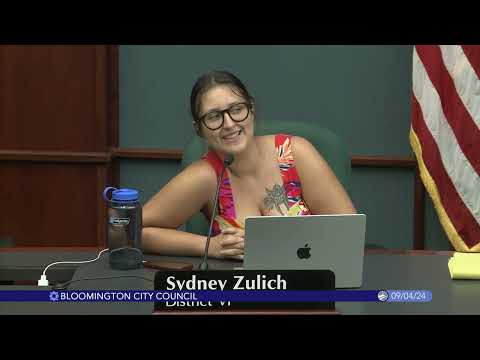
At the start of the evening the council approved a letter of support from the city to accompany a Lilly Foundation grant application from the Community Foundation of Bloomington and Monroe County, which seeks funding for a five-year homelessness-response plan including diversion, housing navigation and intensive case management. Council member Zulek moved to approve the letter; the motion passed by roll call. The president said he would sign and send the letter to the Community Foundation.
Why it matters: Public speakers framed the repeated displacement as a recurrent, disruptive harm affecting elderly people, people with disabilities and households with medical needs. Several council members later acknowledged the urgency and said they wanted immediate and longer-term responses.
What's next: Council scheduled a consensus-building session on Sept. 11 to continue discussion of near- and short-term homelessness responses. The administration and council members also agreed to follow up with advocates and to provide contact paths for people who want the city to reach out.