Get Full Government Meeting Transcripts, Videos, & Alerts Forever!
Get email alerts on the Housing Reuse topic
No spam. Unsubscribe anytime.
Planning commission reviews Dodge City model for renovating abandoned homes
Summary
Members reviewed a Dodge City nonprofit-and-college partnership that rehabilitates abandoned properties using land-bank transfers and a Moderate Income Housing (MIH) grant; commissioners discussed scale, funding, trade capacity and possible local follow-up visits.
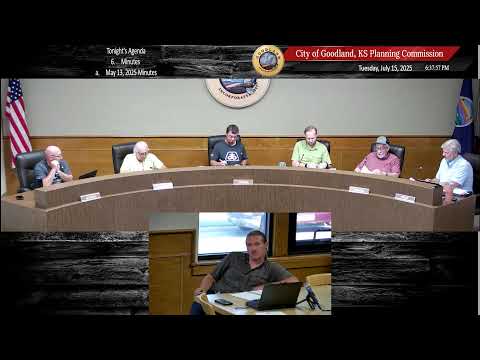
The Goodland Planning Commission on May 27 reviewed a model used in Dodge City, Kansas, in which a nonprofit partners with a community college to rehabilitate abandoned homes and re-sell them to fund future projects. Commissioners said the approach—combining a land bank, a 501(c)(3) nonprofit and grant funding—could be a complement to local demolition and redevelopment efforts.
Commissioners heard that the Community Housing Association of Dodge City (CHAD) partners with the Dodge City Community College building-trades program to build or renovate roughly one new home per year and periodically renovate additional houses. A presenter identified in the discussion as "Chad" said CHAD has produced about 15 homes over a decade and uses a Moderate Income Housing (MIH) grant from the Kansas Housing Resource Corporation to support projects.
"We're building a workforce at the same time while we're building a house," the presenter said, describing hands-on training for students in the building trades.
Board members discussed how properties enter the program: donors can place parcels in a land bank and transfer them to the nonprofit when CHAD is ready to rehabilitate the house. Commissioners said that structure helps avoid tax-liability complications and allows sale proceeds to be reinvested in future projects.
Participants described typical unit sizes and costs from Dodge City: three-bedroom homes of about 1,300 square feet, constructed for roughly $200,000 and sold in Dodge City at about $230,000 to $250,000. The presenters also noted material and volunteer support from partners such as Home Depot.
Commissioners asked practical questions about contractor engagement, volunteer labor and trades shortages. Several members, including local contractors in the discussion, said they'd be willing to volunteer on community projects, while others warned that certain trades, especially plumbing, have limited spare capacity.
Commissioners agreed to pursue follow-up steps including a possible tour of Dodge City projects and placing the topic on the SCCD agenda to explore partnerships and potential funding from local foundations. The commission did not take formal action on the proposal during the meeting.
The planning commission will consider further information and potential next steps at a future meeting.