Get Full Government Meeting Transcripts, Videos, & Alerts Forever!
Get email alerts on the School Parking topic
No spam. Unsubscribe anytime.
Kettering planning commission approves Alter High School parking expansion with traffic conditions
Summary
The commission approved a conditional use amendment to expand Archbishop Alter High School’s northeast parking lot to 164 spaces, imposing circulation, timing and lighting conditions and requiring a city traffic department analysis within one year of opening.
The Kettering Planning Commission voted 5–0 on Aug. 5 to approve a conditional use amendment allowing Archbishop Alter High School to expand a northeast campus parking lot to 164 spaces, subject to conditions aimed at limiting neighborhood traffic impacts.
City staff and the applicant framed the change as an amendment to an existing conditional use and said the expansion required a public hearing under the City of Kettering Zoning Code. Staff recommended approval with conditions drawn from the applicant’s traffic analysis: signage to designate one‑way inbound traffic from East David Road and two‑way flow on Renwood Drive with counterclockwise circulation within the new lot; a minimum 20‑minute gap between Alter and neighboring St. Charles Elementary start times in the morning and a minimum 25‑minute gap in the afternoon; and an extension of the westbound median break on East David Road by 60 feet (to 100 feet).
“Per the recommendation of the traffic consultant,” staff also asked that the two large oak trees shown on the applicant’s plan be retained and that expanded parking‑lot lights be turned off by 10:00 p.m. unless the lot is needed for a scheduled event. The motion further required that, within one year of opening, the city traffic department analyze actual traffic flows and present mitigation recommendations to the Planning Commission.
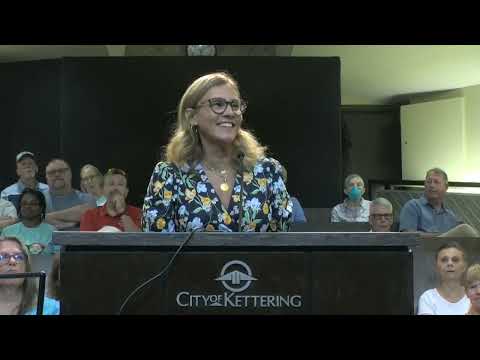
Applicant Lourdes Lambert, principal of Archbishop Alter High School, told the commission the school had held a July 30 neighborhood meeting (200 letters mailed, 20 attendees) and that the school had already moved its schedule: “our new start time is 08:10AM to 03:15PM,” she said, adding that St. Charles begins at 07:50 a.m. and ends at 02:50 p.m., creating 20‑ and 25‑minute separations that the school hopes will reduce congestion. Architect Jason Sheets said design changes retained two larger oak trees along East David Road and reduced the project’s count from an earlier 173 spaces to 164.
Neighbors at the public hearing raised safety and procedural concerns. Teresa Kennison, who lives at 4540 Renwood Drive, said routing egress onto Renwood would be unsafe for children and argued the new lot would make the neighborhood more dangerous: “There’s absolutely no way that you can have all 174 164 spots coming out on Renwood,” she said. Several residents pressed for a traffic study collected during active school sessions rather than the applicant’s traffic analysis; staff and the applicant said the analysis used historical traffic volumes, police incident data and student address distributions to estimate impacts and recommend circulation measures.
Other neighborhood requests were read into the record in a petition that sought, among other items, reducing the expansion to about 80 spaces, requiring a 20‑foot enhanced landscape buffer, limiting lighting use after 10 p.m., moving entrance/exit circulation to David Road only, and enforcing no‑parking rules on adjacent streets during school hours. The Planning Commission chose to approve the applicant’s proposal with the staff‑recommended mitigations and the additional requirement that the city traffic department review real‑world impacts after the lot opens.
The motion was moved and read into the record with the listed conditions; the roll call vote was: Ken Lackey — Yes; Carol Fisher — Yes; Troy Urbis — Yes; Ray Waskey — Yes; Don Rathman — Yes. The commission closed the public hearing and the meeting adjourned at 9:25 p.m.
The commission’s conditions and the one‑year post‑opening traffic analysis are the next actionable steps; residents and staff indicated they expect the city traffic department to return recommended mitigations if the analysis identifies unanticipated neighborhood impacts.