Get Full Government Meeting Transcripts, Videos, & Alerts Forever!
Get email alerts on the Forensic Science Latent Prints topic
No spam. Unsubscribe anytime.
Presenter: "No-value" latent prints show measurable associative value, study finds
Summary
Doctor Stoney presented Phase 1 of an NIJ-funded study finding that latent fingerprint impressions deemed "no value for identification" (NVID) can show measurable associative value. Phase 1 produced a mean expected likelihood ratio near 100,000 and a narrowed analytic set; Phase 2 will test case-level impact with investigators and prosecutors.
Doctor Stoney, a forensic scientist introduced as being in private practice in Northern Virginia, presented Phase 1 results from a National Institute of Justice–funded study testing whether latent fingerprints labeled "no value for identification" (NVID) nonetheless carry associative information useful to investigations.
Stoney said the project has a narrow mission: to measure the potential associative value of NVID latents and to assess practicality for case use, not to validate models of fingerprint individuality or to evaluate examiner decision-making. "We're not trying to validate or improve methods for statistical modeling of fingerprint individuality," he said, adding the study instead aims to establish a factual basis for follow-on work.
Phase 1 collected representative NVID latents from a mix of state, regional and local laboratories. Collection criteria, Stoney said, required that prints had been analyzed and determined to be of no value for identification, be fingermarks (not palms) with at least three well-defined minutiae in sequence, and have high-resolution 1:1 images with identifying case or examiner data removed. A single highly qualified latent-print examiner reassessed submissions to reduce variability across laboratories.
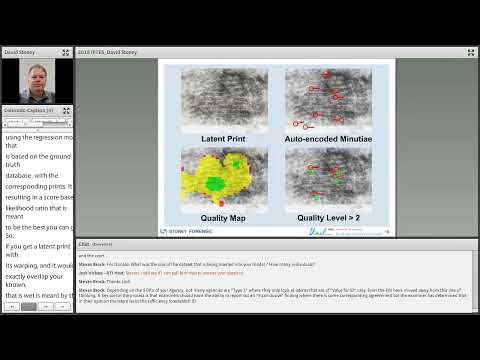
The team used automated feature extraction (a state-of-the-art autoencoder) and quality maps (LQ metrics) to limit retained minutiae, then applied an APHIS score–based likelihood-ratio model calibrated to an existing reference data set. Stoney described this as an "expected maximum" approach that approximates the best associative value obtainable from the latent alone while minimizing the human annotation element.
On sample sizes and screening, Stoney reported about 1,723 images representing a little over 1,000 cases from eight laboratory jurisdictions (as recorded in the presentation). Screening removed roughly one-third of images judged identifiable by the expert; another 5–6% were removed for having fewer than three usable minutiae. From an analytic subset of 344 latents representing 182 cases, further exclusions (including latents producing extremely large expected likelihood ratios cited at about 7,600,000,000) left roughly 208 latents in the final analytic set, Stoney said.
For associative value, Stoney reported a mean expected likelihood ratio around 100,000, with values in the set ranging down to about 100 and up to an arbitrarily chosen cutoff. "There is very strong associative value and potential for usefulness in these prints," he said, while noting historic quality-assurance practices and cutoffs have led laboratories to set these prints aside for a century.
Stoney emphasized variation in occurrence estimates depends on collection procedures and definitions and argued more NVID prints would be available for analysis if collection practices explicitly preserved prints currently dismissed as no-value. He outlined Phase 2 as collaboration with investigators and prosecutors to test whether the associative measures would affect relevance or investigative decisions in specific cases.
The presenter thanked the National Institute of Justice for funding and concluded that Phase 1 supports the theory that many NVID latents are available and have associative value; Phase 2 will examine practical impact in case contexts.