
Senate committee advances substitute restricting firearms and exemptions at polling places
Get AI-powered insights, summaries, and transcripts
Sign Up Free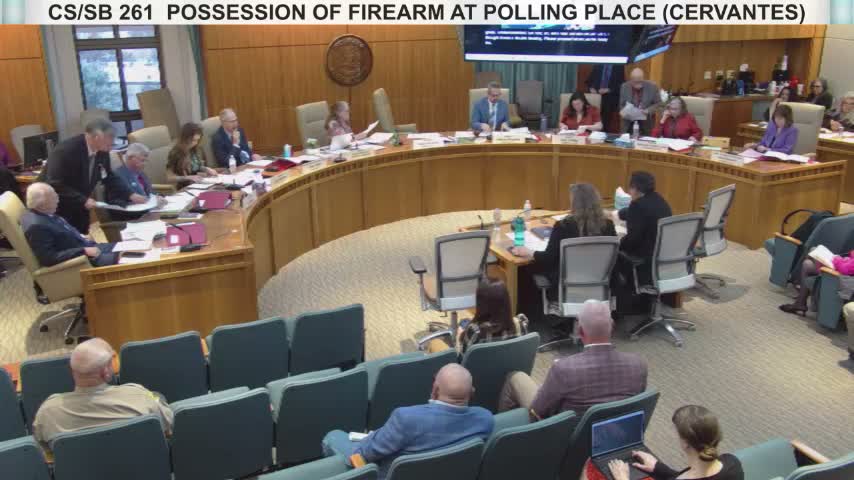
Summary
The Senate Rules Committee granted a due pass to a substitute for SB 261, which narrows exemptions that allow firearms in or near polling places and includes exceptions for law enforcement when requested by election administrators or in emergencies; opponents warned of practical problems in rural areas and for on-site law enforcement.
The Senate Rules Committee advanced a substitute for SB 261 after extended debate about balancing voter safety and the operational needs of law enforcement in small or co-located polling sites.
The sponsor described the bill as a rollback of earlier carve-outs that had left concealed-carry holders and some law-enforcement officers exempt from polling-place firearm bans. Sponsor and Secretary of State staff said the substitute narrows exemptions while preserving the ability for election administrators (presiding judges, election judges, county clerks, or the Secretary of State) to request law enforcement assistance when needed. The bill also creates an offense for intentional obstruction (including actions that block ingress or egress to polling sites beyond the 50-foot zone) and sets out a 100-foot perimeter around polling place entry points while voting is taking place.
Proponents included the League of Women Voters, the Center for Public Policy, and Common Cause New Mexico, who said firearms near polling places intimidate voters and poll workers. "Firearms do not belong in or around polling places where they can be used to intimidate voters and poll workers," a League representative told the committee.
Opponents — including the Zia Rifle & Pistol Club, a San Juan County sheriff's representative, and the New Mexico Business Coalition — urged narrower tailoring. They argued concealed-carry exemptions should be restored or clarified, and warned that many polling places are co-located with law-enforcement facilities, schools with armed SROs, or other locations where disarming on-duty officers would impede safety and response to emergencies.
During questioning senators raised practical scenarios: whether an off-duty or on-duty officer could vote without being forced to disarm, how a sheriff could retrieve and transport ballot boxes in rural counties, and who a voter should call if an armed person creates an immediate threat in line. Secretary of State staff and the sponsor said the substitute aims to be narrowly tailored and included an amendment to allow law enforcement presence when requested by election administrators or to respond to a declared emergency.
The committee took a motion and announced a due pass on the rules committee substitute for SB 261. Senators and witnesses said the substitute was intended to strike a balance between preventing intimidation and ensuring public-safety responders can perform duties when legitimately needed.