
Committee tables bill to extend and expand technology-readiness tax credit after testimony from labs and startups
Get AI-powered insights, summaries, and transcripts
Subscribe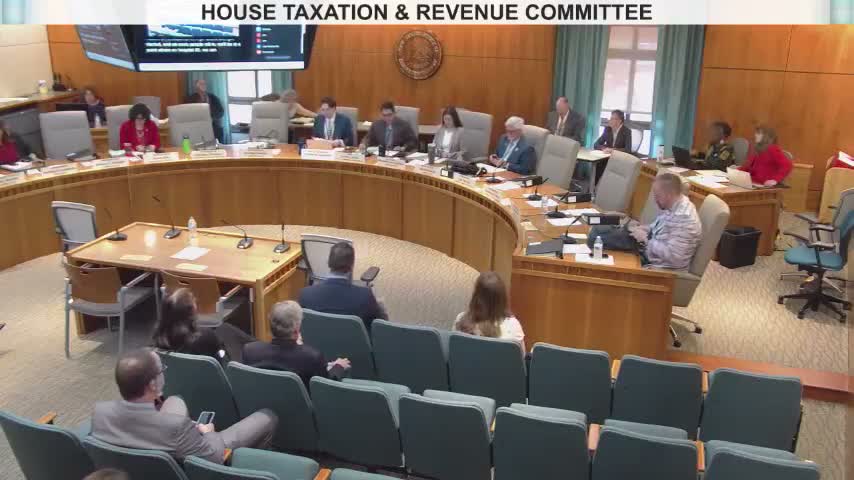
Summary
After extensive testimony from national labs, startups and economic-development groups, the House committee adopted a substitute delaying credit increases and then voted 5–3 to table House Bill 82, which would extend the Technology Readiness gross-receipts tax credit and raise per-lab limits from $1 million to $5 million.
Representative Sanchez told the House Taxation Committee that House Bill 82 would extend and expand New Mexico’s Technology Readiness gross receipts (TRGR) tax credit, a program that connects state businesses with national laboratory expertise. “What this bill does is this bill extends the current credit by 10 years to allow for continued access to the labs by New Mexico business,” Sanchez said, adding the measure increases per-lab annual limits from $1,000,000 to $5,000,000 and delays the start of incremental increases to hit the fiscal-year 2028 budget.
Experts from both national laboratories described the program’s role in maturing complex, capital-intensive technologies. Candace Steventhal of Los Alamos National Laboratory said the program aids work in “areas like quantum computing, hypersonics, advanced energy,” and lets labs and industry move early-stage research toward commercialization.
Numerous business leaders and startup founders testified in support. Ed Parma, chief science officer for Eden Radioisotopes, said his company used two TRGR awards and that the credit’s lab support is “unburdened at the labs, which allows you to get a lot more work done there than paying for it directly.” Matt Jones, founder of a diagnostic startup working with Sandia, said the program helped the company de-risk lab technology and speed up diagnostic development.
Committee members pressed witnesses for concrete outcomes. A lab witness described a Santa Fe firm, Cleanopolis Solutions, that used lab-derived prototypes to run a municipal demonstration and currently employs interns the company hopes to convert to full-time staff. The same witness said an out-of-state firm recruited by the labs, Space Kinetics, established operations in Albuquerque, hired seven people and raised “over $10,000,000.” A witness estimated the average salary for these high-tech positions at “over $92,000.”
After questions, Vice Chairwoman moved to table HB 82. The committee conducted a roll call and the chair announced the motion to table carried by a vote of 5 to 3. The chair explained the committee practice of tabling bills that have a fiscal impact until tax-package capacity is clear and said the substitute adopted earlier delays the fiscal effect until FY28. The bill was therefore tabled rather than advanced to the floor.
The committee adopted a committee substitute (no. 233875.1) earlier in the hearing that pushes the start of the incremental increase to FY28; that substitute was distributed and agreed to before public testimony.