Senate committee approves Physical Therapy Licensure Compact bill with clarifying amendments
Loading...
Summary
The Senate committee voted 9–0 to recommend House Judiciary substitute for House Bill 12, which would join New Mexico to the Physical Therapy Licensure Compact. Lawmakers added amendments clarifying data handling, federal‑court standing, and attorney‑general roles while hearing support from therapy providers and concerns from trial lawyers about immunity and 'loser pays' provisions.
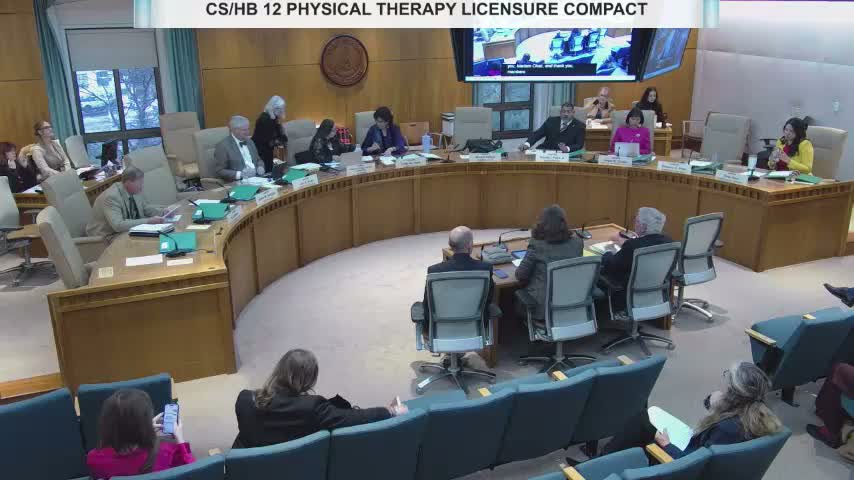
The Senate committee on Friday recommended passage of House Judiciary committee substitute for House Bill 12, the Physical Therapy Licensure Compact, after adopting clarifying amendments addressing data access and legal standing.
Supporters said joining the compact would ease licensure for out‑of‑state therapists and help recruit needed clinicians. "House Bill 12 increases access to care by including New Mexico in the Physical Therapy Licensure Compact," said JD Bullington, speaking for the Greater Albuquerque Chamber of Commerce. Noah Podaca of Think New Mexico told the committee New Mexico lacked about 526 physical therapists compared with national benchmarks and said the compact, with many member states, would speed recruitment.
Committee staff and analysts described the amendments adopted on the floor of the committee. "The first amendment clarifies references to criminal background checks," said Bob Horowitz, a house majority analyst who worked with the bill sponsor. He said other changes limit the compact commission’s data system to investigative or disciplinary information concerning New Mexico licensees, give New Mexico the option of using a federal court in the state in certain enforcement actions, and assign the attorney general a role in contingent repeal proceedings so affected individuals can work with the AG rather than suing the commission directly.
Trial lawyer Felice Bridal said she supported the bill overall but urged caution on immunity, venue and a "loser pays" provision she said appeared on pages 30–31 and could impede access to justice. "We don't oppose this bill," Bridal said, "but I wanted to raise a couple of concerns," citing the listed provisions.
Committee members discussed whether the compact commission must sign off on any state changes; sponsors said language had been negotiated with commission representatives but that final approval by the interstate commission remained necessary. Several senators called the work "a work in progress" as states negotiate uniform compact terms.
After adopting the amendments and taking final questions, the committee moved a "do pass" recommendation. Senator Hickey moved the motion with a second from Senator Charlie; the roll call returned a 9–0 vote in favor of a due‑pass recommendation for the House substitute for HB12 as twice amended.
The bill now moves to the Judiciary committee (procedural route specified in the committee's process). If enacted, HB12 would allow New Mexico to participate in the compact and provide a streamlined pathway for physical therapists licensed in other member states to practice in New Mexico, subject to any conditions the compact commission requires for member acceptance.
The committee indicated it would continue coordinating with compact attorneys to resolve outstanding language before final acceptance by the interstate commission.