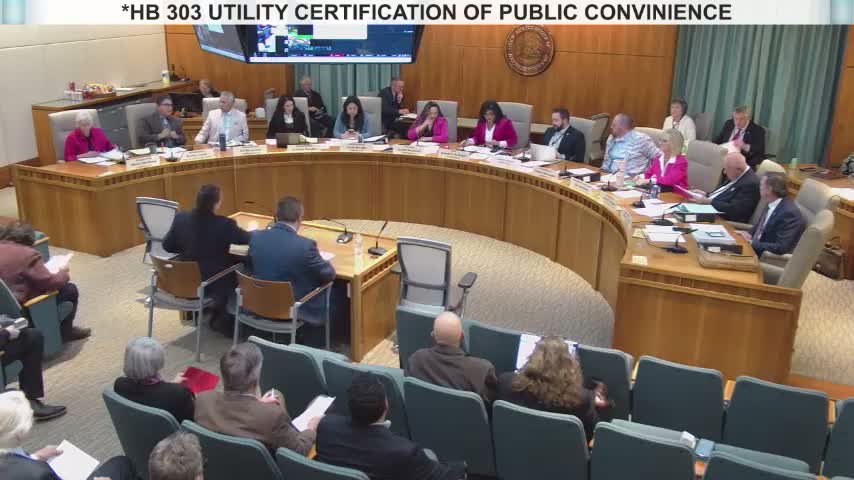
Committee tables memorial seeking study of private equity ownership of utilities after wide public debate
Loading...
Summary
House Memorial 6, which would have directed the Legislative Finance Committee to study private equity involvement in critical utilities and whether the state should consider an ownership stake, drew extensive public testimony for and against and was tabled by the committee (final tabling vote recorded 8‑3).
Lawmakers on the House Commerce and Economic Development Committee tabled House Memorial 6, a proposal requesting a study of private equity ownership in essential utilities and the feasibility of state equity involvement. The session featured extended public comment from advocacy groups, legal experts and industry representatives who sharply disagreed about the need for and possible consequences of such a study.
The sponsor presented the committee substitute as a request for the Legislative Finance Committee to evaluate private equity involvement in critical New Mexico utilities and to explore whether the state should consider taking an equity stake in such companies. The sponsor emphasized the measure was a study, not a directive to buy or nationalize utilities.
Proponents urged caution about private equity acquisitions and cited Blackstone’s proposed acquisition of PNM as a focal point. Eleanor Bravo, chair of the board of New Energy Economy, said the acquisition raised concerns about shifting costs and risk to ratepayers if private equity ownership prioritized profit. "This memorial is so critical," she said, urging objective analysis before irreversible decisions.
A wide range of public testimony backed the memorial, including real‑estate and environmental groups, former regulatory attorneys and grassroots coalitions who warned about concentration of ownership and called for data‑driven analysis of affordability, reliability and long‑term public benefit.
Opponents included speakers representing PNM, Xcel Energy, El Paso Electric, Blackstone Infrastructure counsel and business groups such as New Mexico IDEA and local chambers. They argued the PRC already adjudicates acquisitions, the memorial could create duplicative or prejudicial processes, and that a study or the appearance of legislative involvement could inject harmful market uncertainty and risk delaying needed investments.
Dean Archuleta of PNM told the committee that PNM serves roughly 500,000 customers in the state and that recent operations were over 70% carbon free; he warned that a study that delayed or altered the regulatory review could pose due‑process concerns and affect investment. Blackstone counsel said the company intends to preserve local commitments to affordability, reliability and local workforce conditions if an acquisition proceeds.
Committee members raised questions about timeline overlap with the PRC adjudication, potential conflicts if state funds were used, the expertise needed to study complex transactions, and whether the memorial might create the appearance of influencing an ongoing adjudicatory process. The memorial’s expert and sponsors repeatedly said it did not require the PRC to pause its proceedings and that staff input would not bind commission adjudications.
After procedural motions and debate, the committee voted to table the substitute/memorial; the chair announced a final tabling tally of 8 votes yes and 3 votes no. Members who supported tabling said the memorial as drafted was not ready or risked creating false hopes; members opposed to tabling said a study could illuminate options beyond simple public vs private binaries.
The committee concluded its meeting following the tabling action; the memorial remains tabled in committee.