Get Full Government Meeting Transcripts, Videos, & Alerts Forever!
Get email alerts on the State Legislation topic
No spam. Unsubscribe anytime.
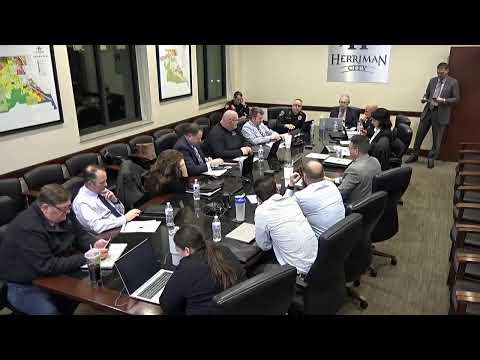
Herriman council hears detailed state-legislation briefing; moves to closed session
Summary
Council staff reviewed a long package of state bills — including proposed audit powers (SP 154/SJR 4), a fluoride ban (HB 81), agritourism code exemptions (HB 433), mining preemption (HB 355) and a 7,223-line land-use bill (HB 368) — and the council voted to recess to a closed session under Utah Code §52‑4‑205.
Council staff presented an extended legislative update that flagged a series of state bills of potential interest to Herriman and described likely impacts and next steps. Unidentified Speaker 5 summarized a suite of items and repeatedly urged the council to monitor specific language and, where necessary, reach out to legislators.
On the proposed legislative audit amendments (SP 154 and companion SJR 4), Unidentified Speaker 5 said the bills would allow the legislative auditor general to demand information from lawyers representing entities under audit — potentially including attorney‑client communications — and reported ethical concerns and opposition from the Utah State Bar. "It seems like there is support from several of the senators because there was a problem with the AG's office," Unidentified Speaker 5 said, later calling the use of attorney‑client privilege in that case an "improper use." Council members asked whether judicial in‑camera review could be used; staff said the bill sponsor has resisted judicial oversight.
On HB 81, a fluoride-related amendment, staff said a Davis County water provider asked whether Herriman would support prohibiting addition of fluoride to public water systems. Several speakers noted large regional water districts and some counties had taken supportive positions, but others raised concerns about associating the city with groups named on circulated materials (specifically Utah Parents United) and cautioned about endorsing third‑party flyers.
Unidentified Speaker 5 highlighted HB 433 (agritourism building amendments), which could create state exemptions to building-code requirements for agritourism structures, and urged staff and council to seek clarification about historic‑building exceptions and the bill's practical effect on older agricultural facilities.
On HB 355, described as a critical‑infrastructure/materials bill by Sponsor Snyder, staff cautioned the measure would let mining companies begin certain excavation or material extraction without matching local zoning, effectively preempting local land‑use control; council members were advised to prepare public‑record statements showing any imminent public‑health or safety danger if the city later faces permit requests.
The largest item discussed was HB 368 (local land‑use amendments), a multi‑thousand‑line bill staff described as 7,223 lines long. Speakers said the bill mixes items that could streamline municipal practice with provisions that remove local enforcement tools — for example, language about landscaping plans and restrictions on withholding a certificate of occupancy — and expressed frustration that omnibus bills of that length make careful review difficult. The group discussed strategy: whether to pick a few bills for concerted opposition or to try broader pushback through the League of Cities and Towns.
Other items discussed included AI disclosure requirements for law‑enforcement reports, a state proposal to bar quotas for officers (SP 243), and school‑safety amendments (HP 40). After the legislative update, Unidentified Speaker 1 moved that the council recess to a closed meeting under Utah state code section 52‑4‑205 to discuss pending or imminent litigation, real‑property negotiations or development agreements, and deployment of security personnel devices or systems; the motion was seconded and carried after roll call.
Council staff said they would keep the council updated on bill language and suggested targeted outreach to legislators on bills where language could be improved or where strong local impacts were likely.