Get Full Government Meeting Transcripts, Videos, & Alerts Forever!
Get email alerts on the E Bikes And Micro Mobility Safety topic
No spam. Unsubscribe anytime.
South Jordan police outline e-bike rules, safety after local incidents
Summary
Sergeants Anderson and Scribe of the South Jordan Police Department held an outreach at Hangar 15 Bike Shop to explain which electric bicycles and scooters are legal, warn about recent incidents involving riders, and review lighting, age and registration requirements.
Sergeant Anderson and Sergeant Scribe of the South Jordan Police Department spoke at an outreach event at Hangar 15 Bike Shop on Woodward Road to clarify local rules for electric bicycles and scooters after recent incidents.
The officers said distinguishing low-speed e-bikes that operate like bicycles from faster, motorized vehicles is key to safety and legal compliance. Sergeant Anderson said, “E bikes with working pedals like a bicycle that don't exceed 20 miles per hour, 2 wheeled scooters that don't exceed 20 miles per hour,” adding these devices “follow the same rules as bicycles, so ride safe, yield to pedestrians and stay alert.”
Why it matters: the department cited a series of incidents that prompted the outreach. Sergeant Scribe said safety is the “number 1 concern,” noting a recent case in which “a child [was] being hit by someone riding an e bike” and separate incidents of property damage at local schools and golf courses. The officers said clearer understanding of which devices require registration and licensing can reduce risks to pedestrians and property.
What is allowed and how devices are classified: the officers described e-bike classifications and operational limits. Sergeant Scribe explained that e-bikes are classified as class 1, class 2, or class 3 and that each class carries different age and operational restrictions. The department said e-bikes and scooters that keep to 20 mph and have working pedals are treated like bicycles for most purposes.
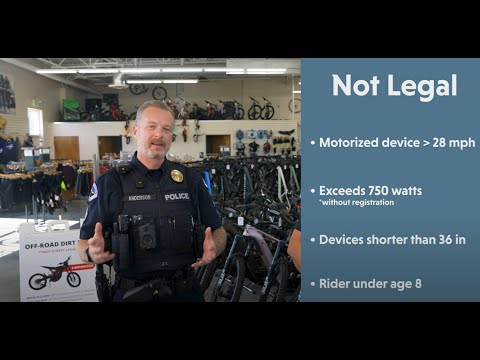
What is not allowed and regulatory requirements: Sergeant Anderson warned that “any motorized device that goes over 20 miles per hour or exceeds 750 watts without registration” is treated differently under local rules. He said certain small or recklessly operated motorized devices (for example, very short devices or those used in a reckless manner) require registration, insurance and a driver's license and should not be ridden on sidewalks.
Safety equipment and age guidance: the officers reminded riders that operating after dark requires a working headlight and a rear reflector. They also conveyed age-related guidance presented at the event: riders under 14 should have adult supervision, and very young children should not operate e-bikes — the presenters stated no one under 8 should operate an e-bike. The officers framed these points as practical safety limits rather than criminal-sentence thresholds.
Community outreach and next steps: the event at Hangar 15 Bike Shop was positioned as public education; the officers encouraged attendees to check their bikes, ask questions, and follow the rules to keep trails, parks and sidewalks safer for everyone. The outreach did not announce new ordinances or formal changes to policy at the meeting.