Get Full Government Meeting Transcripts, Videos, & Alerts Forever!
Get email alerts on the Public Safety topic
No spam. Unsubscribe anytime.
Salt Lake City reports progress on six‑month public safety plan; calls for state funding to scale shelter and services
Summary
City officials said 12 of 27 city actions from the public safety plan are complete or ongoing, highlighted narcotics and firearm seizures by a specialized team, launched Project Connect data‑sharing for high utilizers of justice and social services, and asked the state for sustained operational funding for shelter capacity.
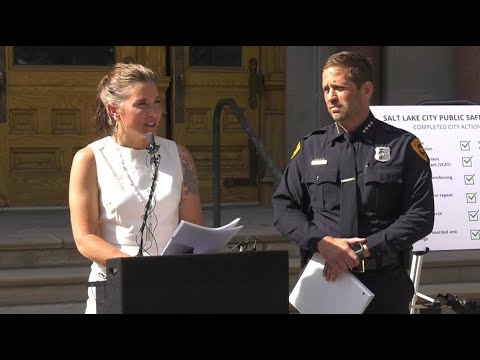
A city official delivering a six‑month update on Salt Lake City’s public safety plan said the city has completed or is actively implementing a majority of its 27 city‑led strategies and that local investments and new programs are beginning to show results.
"12 of the city's 27 actions are complete and remain ongoing," the official said, highlighting a nearly $4,000,000 package of public‑safety initiatives in the fiscal year budget that took effect July 1 and a separate $5,000,000 commitment for deeply affordable housing this year.
The update emphasized a mix of law‑enforcement activity and expanded social supports. Officials described the Violent Crime Apprehension Team (VCAT) as an early success: "Just last month, VCAT seized 760 fentanyl pills, 30 grams of meth, 37 grams of crack cocaine, and $4,300 in cash, all from a single search warrant," the speaker said. City officials also said over the past six months VCAT's work produced thousands of fentanyl pill seizures, more than 20 pounds of narcotics and nearly 100 illegally possessed firearms.
Police leaders described a two‑part strategy, combining accountability for people who victimize others with more intensive help for people experiencing complex challenges. "People that have very complex challenges, we need to get really good at delivering the help that they need," a police speaker said, summarizing the department’s approach to coordinating criminal‑justice and social‑service responses.
The city has created a Community Impact Division (CID) that focuses patrols on downtown, the Jordan River Trail and the Ballpark neighborhood; CID bike units, officials said, seized over 5,000 fentanyl pills and more than $11,000 in cash in a single Cottonwood Park arrest. Officials reported an increase in enforcement metrics this year, including more than 5,300 jail bookings and higher officer proactivity, while cautioning that some measures — such as residents’ "feeling of safety" — are distinct from crime counts.
Project Connect, the new interagency data‑sharing initiative the city described, aims to identify the highest utilizers of the criminal‑justice and social‑services systems and connect them with housing, treatment and wraparound services. Early results shared at the briefing said that within weeks about 16% of targeted individuals engaged in treatment and an additional 26% had been assessed or referred to resources; one person was reunited with family out of state.
Officials also noted new and expanding non‑enforcement efforts: an Urban Services Division that includes a Clean City team for graffiti removal and debris cleanup, an expanded Rapid Intervention Team for livability issues, and a contract for a pilot bringing free restrooms, showers and laundry facilities for people living on the streets. The city said it had expanded winter shelter into summer months and added roughly 400 shelter beds compared with a year earlier.
City leaders repeatedly called out the limits of municipal authority, saying several plan elements require state operational funding and statutory change. The speaker said the city offered city‑owned land for a temporary shelter campus contingent on state or philanthropic operations funding; the state is considering the site for a permanent facility and progress has stalled. "We need the state to act to fully fund development and ongoing operations for this state owned campus," the official said.
The briefing also addressed civil‑liberties concerns tied to technology. Officials said the city plans more cameras, drones and a real‑time crime center to support investigations and response times, but that policy work and public consultation — including meetings with the ACLU — will guide deployment.
During a question‑and‑answer session, officials reiterated that many policy proposals from the public safety plan depend on legislative action or county funding, singling out requests for additional ACT (assertive community‑based treatment) funding and other state supports that did not pass in the most recent legislative session.
The city posted its six‑month report online at slc.gov/publicsafetyplan and said it will continue to publish updates as programs roll out.