Get Full Government Meeting Transcripts, Videos, & Alerts Forever!
Get email alerts on the Texas Cyber Command topic
No spam. Unsubscribe anytime.
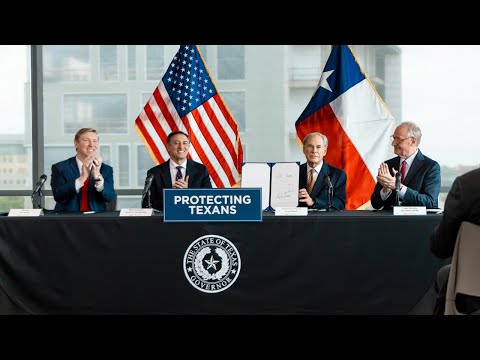
Gov. Greg Abbott signs HB150 to create Texas Cyber Command in San Antonio
Summary
Governor Greg Abbott signed HB150 at UTSA, establishing the Texas Cyber Command with about $135 million in state investment and San Antonio as its headquarters; lawmakers and federal partners said the command will coordinate threat intelligence, response and training for state and local governments.
SAN ANTONIO — Governor Greg Abbott on Tuesday signed HB150 into law at the University of Texas at San Antonio, establishing the Texas Cyber Command and directing a state investment of about $135 million to build a centralized cyber threat-intelligence and response capability headquartered in San Antonio.
Taylor Amie, president of UT San Antonio and acting president of UT Health San Antonio, opened the event and credited the governor and the bill sponsors, saying the university and the UT System “stand ready to support the command.” Sen. Tan Parker and Rep. Giovanni Capriglione were thanked by speakers for carrying the legislation through the Legislature.
Abbott described the command’s mission as preventing and protecting against cyber breaches, creating a cyber threat intelligence center to identify and repair weaknesses in state and local systems, training users, and coordinating swift responses to attacks. “They will launch a cyber threat intelligence center to identify and repair weaknesses in state and local government systems,” Abbott said.
Abbott and other speakers repeatedly cited San Antonio’s concentration of cyber expertise — including the 16th Air Force Cyber Mission, the National Security Agency (NSA), the FBI, the Secret Service, the Department of Homeland Security, and the Southwest Texas Fusion Center — as a reason to base the command in the city. UTSA was also described as a leading local source of cyber talent and programs.
State Representative Kirk Picclione, who introduced brief remarks after the signing, recalled that a UTSA-hosted House select committee on cybersecurity met about seven years ago and said the new command will provide “a one-stop place” to focus protection for constituents and businesses. Senator Tan Parker, who helped sponsor the bill, called the command a foundational step to protect Texans and to lead on cyber, artificial intelligence and quantum technologies.
Officials at the event also thanked Mandy Crawford of the Texas Department of Information Resources (DIR) and emergency-response leaders such as Nim Kidd of the Texas Division of Emergency Management and Colonel Freeman of the Texas Department of Public Safety for their roles in developing the concept.
The bill was presented as an emergency priority by the governor during the legislative session; Abbott signed the measure at the UTSA event and said, “The Texas Cyber Command is now the law of the state of Texas.” The signing places the command’s headquarters in San Antonio and allocates the state investment to stand up the organization and its initial programs.
The ceremony featured federal and local partners in the cybersecurity ecosystem, and officials said the command will coordinate with local, state and federal agencies to establish a “gold standard” for cybersecurity. The announcement did not include a detailed implementation timeline or a breakdown of how the $135 million will be spent; those allocations and next steps were not specified at the event.
Separately, toward the end of his remarks the governor spoke at length about immigration and national politics, advancing assertions about border enforcement and past federal policy; those comments were framed by participants as separate from the cyber-command signing and were not presented as part of the command’s authority or funding plan.
The law takes effect under the timetable specified in HB150; the event did not provide additional committee or administrative schedules, and officials at the signing said they would coordinate further implementation with UT System, DIR and federal partners.