Get Full Government Meeting Transcripts, Videos, & Alerts Forever!
Get email alerts on the Municipal Finance topic
No spam. Unsubscribe anytime.
Layton posts clean FY2025 audit; city finance leaders highlight healthy reserves and a paper accounting adjustment
Summary
Auditors gave Layton City an unmodified (clean) opinion on its fiscal 2025 financial statements and flagged a $141,000 GASB 87 lease accounting entry that produced an overage on a partner agency's books; officials emphasized strong reserves and ongoing capital commitments.
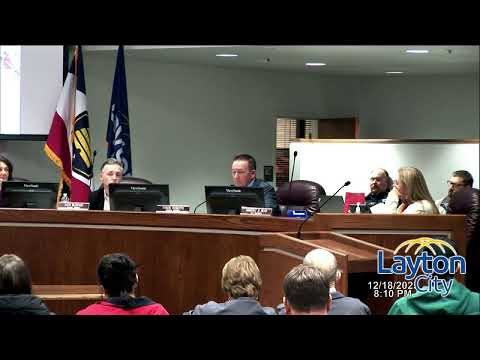
Layton City Council on Dec. 18 received the city's fiscal year 2025 comprehensive financial report and a clean audit opinion from independent auditor Robert Wood.
"We have given you a clean opinion," Robert Wood told the council, reporting that the city's financial statements are fairly presented and that auditors found no material misstatements or material weaknesses in internal control testing. The single-audit review covered more than $8 million in federal expenditures, including ARPA funds tied to local projects.
Finance director Tracy Probert walked the council through revenue and expenditure trends, noting stronger-than-expected sales tax receipts and an unassigned fund balance of $11,140,000. Probert said much of the apparent under‑budgeting reflected unspent purchase orders and staffing vacancies; on a combined basis the city's reserve calculations place the general fund near management targets.
Auditors identified one reporting issue tied to GASB 87 lease-accounting rules. When a partner unit, the Davis Metro Strike Force, entered multiyear leases for vehicles the accounting standard required recognition of a right-to-use asset and corresponding expense, producing a $141,000 budget variance. Wood described that variance as a "paper entry" that did not involve cash flow but required a late reporting adjustment.
The auditor also noted that the city reports more than $8 million in federal expenditures for the year and that the schedule of expenditures of federal awards reconciles with audit work; a Weber Basin-related project was discussed as an example of a subrecipient relationship that required additional documentation. City staff said roughly $1,000,000 of a $2,500,000 Weber Basin allocation has been spent to date.
Council members and staff emphasized the city's conservative approach to debt and long-range capital planning. Probert said the city has committed roughly $30,000,000 in capital-project funding currently held in the capital projects fund, and auditors praised the city's low overall debt position compared with peer municipalities.
The council received the report and approved it as part of the consent agenda; no separate roll-call vote with individual tallies was recorded during the meeting.