Get Full Government Meeting Transcripts, Videos, & Alerts Forever!
Get email alerts on the Bail Reform topic
No spam. Unsubscribe anytime.
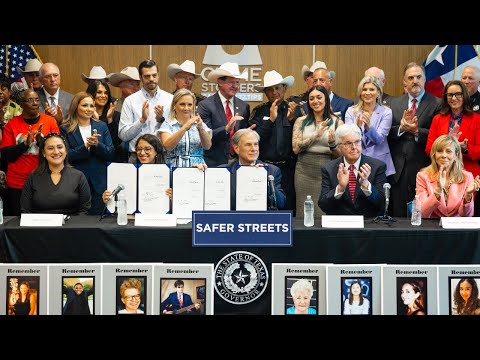
Gov. Greg Abbott signs package to restrict bail for violent offenders, urges voters to approve constitutional amendment
Summary
In Houston, Gov. Greg Abbott signed bills aimed at limiting pretrial release for violent defendants, giving prosecutors immediate appeal rights for bond decisions, barring certain magistrates from setting high-risk bonds and restricting taxpayer-funded bail. Officials urged voters to pass the related constitutional amendment, SJR 5, in November.
HOUSTON — Governor Greg Abbott signed a set of criminal-justice measures in Houston that state leaders said will tighten pretrial release for violent defendants and give prosecutors new tools to keep high-risk people behind bars.
The measures — which officials named at the event as Senate Bill 9, Senate Bill 40, House Bill 75 and Senate Joint Resolution 5 (SJR 5) — were described by Abbott and advocacy groups as responses to what they called a broken bail system in which repeat violent offenders were released and later committed new crimes. "This is a day of reckoning," Rania Mankarios, CEO of Crime Stoppers of Houston, said at the bill-signing event.
Abbott said judges will no longer be able to grant bail in violent cases when a prosecutor demonstrates the defendant is a flight risk and a danger, and that judges who do release violent defendants must explain their decisions in writing. "Prosecutors will now have a new tool," Abbott said, adding that prosecutors will have the right to appeal a judge's bond decision and that while that appeal is pending the defendant will remain in custody. He also said unaccountable magistrates will be barred from setting bail in the most dangerous, high-risk cases and that nonprofits will be prevented from using public tax dollars to pay bail for criminals.
The governor cited a case he said illustrated the stakes: Austin Collette, whom he described as charged and later convicted of murder, was released on bond and later killed again, according to Abbott's remarks. Those details were offered by Abbott as an example of the problem the new laws aim to address.
Supporters framed the package as bipartisan and credited victims and advocacy groups with pushing the measures through the Legislature. "These were the lives of dearly beloved individuals," Mankarios said, speaking of data and family testimony gathered by Crime Stoppers. Sen. Joan Huffman, who helped lead the legislation through the Senate, said she hoped the changes would give victims' families "some measure of peace." Andy Khan, director of victim services for Crime Stoppers of Houston, recounted investigative work showing defendants who failed to appear for court dates and later committed new violent crimes.
Officials acknowledged implementation questions. Abbott said state officials and sheriffs calculated what the changes might mean for jail populations and that the state would provide resources if local jails required additional capacity. "We as a state understand it's a priority to keep dangerous, murderous criminals off the streets," he said.
The constitutional change in SJR 5 must be approved by voters to take effect. Speakers at the event urged Texans to vote for the amendment in November; Abbott and other officials suggested they expect broad support at the ballot box.
The event also included emotional testimony from victims' family members. Amy Castillo told the crowd that her brother, Joshua Sandoval, was killed on May 27, 2021 by a defendant who she said had been out on multiple felony bonds; she announced the formation of Texas Crime Victims United to advocate for families like hers. "I am proud to tell my brother he became a catalyst for change," Castillo said.
Next steps: the bills signed at the event become law as provided by state procedure; the constitutional amendment in SJR 5 must be approved by Texas voters in the November election to become part of the state constitution.
(Reporting note: Quotations and attributions come from remarks delivered at the signing event in Houston.)