Get Full Government Meeting Transcripts, Videos, & Alerts Forever!
Get email alerts on the Regulatory Reform topic
No spam. Unsubscribe anytime.
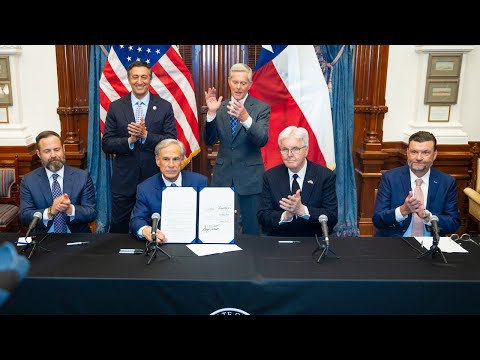
Gov. Greg Abbott signs SB 14 to create Texas Regulatory Efficiency Office
Summary
Gov. Greg Abbott signed Senate Bill 14 into law, establishing a Texas Regulatory Efficiency Office that officials say will tighten standards for new rules and host a public portal for regulatory reviews. Business groups at the ceremony hailed the measure as a win for small business.
Gov. Greg Abbott signed Senate Bill 14 into law during a bill-signing event, establishing the Texas Regulatory Efficiency Office to review new rules and, officials said, put stricter standards on future regulations to limit growth of the administrative state.
Abbott framed the measure as part of an effort to make government "more responsible, more responsive, less costly, and more efficient," and said the law "will ensure that Texas is operating at the speed of business." He declared, "Texas regulatory reform is now law in the state of Texas." (remarks appear in the event transcript.)
Supporters at the ceremony said the office will reduce unnecessary rules and increase transparency. Jeff Burdette, identified in the transcript as a director with the National Federation of Independent Business, said the bill is a culmination of recommendations from the Small Business Freedom Council and praised its public-portal feature, which he said will let "any citizen" view the same regulatory review materials that legislators and officials see.
Transcript remarks from Abbott cited an unspecified study that, he said, found Texas had "the fifth-highest regulatory burden of any state," a finding Abbott called "completely unacceptable." The governor also recounted a April 2020 meeting with Elon Musk—Abbott said regulators moved quickly to enable construction of a "cyber auto manufacturing company" in Austin, which Abbott said went from "turning dirt to rolling vehicles" in less than 18 months; these examples were presented as evidence Texas can streamline approvals for business. Those characterizations are reported as statements by Abbott in the transcript and are not independently verified in this story.
Officials described core features of the new office as: stricter standards for imposing new regulations; a mechanism intended to check growth of agency rulemaking; and a public-facing portal to increase transparency over regulatory reviews. The transcript contains supporters' characterizations that the office will "slash regulations" and save taxpayers money; the text of SB 14 and administrative guidance will determine how the office operates in practice.
During a short question-and-answer exchange, a questioner asked whether there are particular sectors that offer "low-hanging fruit" for cuts and whether SJR3 had been delayed in the House. Abbott replied, "I'm hearing it for the first time, so I don't know exactly what you're talking about," and said not everything will pass immediately and that the session will involve give-and-take among legislators.
The bill-signing event brought elected leaders and business representatives together to highlight the law's goals. The transcript records praise from legislative speakers and business groups but does not include a roll-call vote or implementation timeline for the new office. Abbott and others said they expect additional legislative activity during the session; the transcript does not specify a date when the office's rules or portal will go into effect.
The office created by SB 14 will have to be implemented by state agencies and its operating procedures set out in rulemaking and administrative guidance; those implementation steps and any future legislative refinements were not described in detail during the ceremony.