Get Full Government Meeting Transcripts, Videos, & Alerts Forever!
Get email alerts on the School Choice topic
No spam. Unsubscribe anytime.
Texas leaders press for universal school choice as House committee prepares vote; questions about cost and access persist
Summary
Governor Greg Abbott, Lt. Gov. Dan Patrick and Speaker Dustin Burrows urged passage of a universal school choice package the Texas Senate approved, while reporters pressed leaders on a Legislative Budget Board projection of long-term costs and how low-income families would access private schools.
Governor Greg Abbott and top Texas leaders urged lawmakers on Wednesday to approve a universal school choice package that the Texas Senate has already passed and that the House Public Education Committee is expected to take up next week.
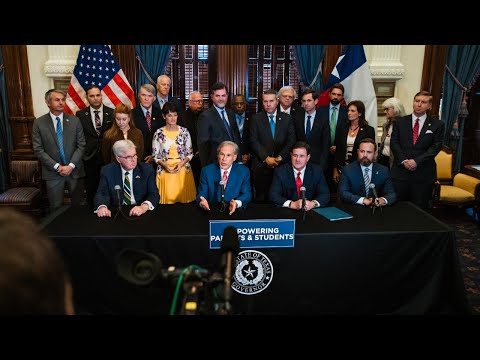
Abbott, standing with Lieutenant Governor Dan Patrick, Speaker Dustin Burrows and former Arizona Governor Doug Ducey, said the proposal is a step toward making Texas "number 1" in education and argued the state can both fully fund public schools and expand parental choice. "School choice is so important for parents," Abbott said. "No one knows better than a parent the power and the importance of school choice for children."
The stakes include competing claims about the program's size and cost. A reporter cited a Legislative Budget Board estimate that the bill could cost about $4 billion by 2030; Abbott rejected that projection as "based on nothing but fiction," saying the legislature alone decides appropriations and that the amount likely to be allocated this session is about $1 billion. Lieutenant Governor Dan Patrick described the proposal as a ‘‘billion dollars and a hundred thousand students’’ launch and said participation levels will determine future funding needs. "So anyone who says that we are undermining education, that is simply a total lie," Patrick said.
Former Arizona Governor Doug Ducey, who led Arizona's multi-year effort to implement universal school choice, told the audience Arizona's rollout was popular and, he said, compatible with improved teacher pay and fiscal results in his tenure. "These kids are trapped in failing public schools, and it's time to set these families free," Ducey said, describing school choice as an issue of opportunity and civil rights.
Speakers from the governor's office and the legislative leadership framed the initiative as paired with continued support for public education. "We can fully fund public education and provide meaningful opportunities and competition through school choice at the same time," Speaker Dustin Burrows said, noting the House intends to move a school finance bill and a comprehensive school choice bill through committee and then to the floor.
Reporters pressed leaders on access for low-income families, including concerns about transportation and other out-of-pocket costs that can prevent families from using private schools. Patrick and Ducey said many families who use choice programs earn below the average working wage and that some private schools offer additional scholarships; Ducey also described charter-school demand as evidence of parental willingness to pursue alternatives.
Abbott cited private-school availability around specific areas, saying he had reviewed maps of South San Antonio and Houston's Fifth Ward and found private-school options within about a 10–15 mile radius that could participate if the program expands.
Next steps: speakers said the House Public Education Committee is expected to pass related bills early next week, after which the measures would go to the full House. No formal vote on this package was recorded at the press conference.