Get Full Government Meeting Transcripts, Videos, & Alerts Forever!
Get email alerts on the Economic Development topic
No spam. Unsubscribe anytime.
Council hears hotel and tax-impact models tied to proposed athletic complex; members ask for deeper study
Summary
Economic-development staff presented hotel-demand and tax-revenue scenarios related to a proposed athletic complex; the model showed modest direct gains under conservative assumptions, and councilors called for a comprehensive city-level economic impact study before making decisions.
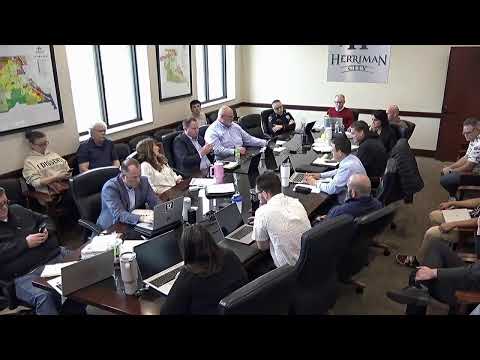
Herriman City Council heard a presentation on economic scenarios tied to a proposed athletic complex and potential hotel development, followed by extended council discussion on model assumptions and next steps.
Trevor (Speaker 10) presented hotel-demand scenarios and cautioned that the analysis is highly sensitive to assumptions about how many hotels would locate in the city. "All of this is guesswork," he said, describing a baseline in which two hotels might locate with or without the complex and a tournament-driven occupancy premium that could raise annual TRT/sales-tax capture. In the example Trevor presented he reported "about $7,600 more per year" in direct city captures in a narrow scenario where tournament nights raised occupancy by 10%.
Councilors noted several caveats. Multiple speakers said the larger benefit depends on whether the complex induces additional commercial development — in particular whether additional hotels locate in Herriman and whether restaurants and retail follow. "You need a much more in-depth comprehensive analysis to determine that," Speaker 1 said, urging a city-specific economic impact study and commercial partner engagement rather than relying solely on regional studies.
Public concerns tied to the athletic complex — noise, lights, parking and gated access — were discussed in tandem with the economic model. Staff and councilors raised mitigation ideas such as no-through access to adjacent neighborhoods, shuttle agreements with nearby schools for event parking and design-phase limits on hours and lighting to reduce disturbance.
Council members agreed further work is needed to convert regional impact estimates into an evidence-based projection of local capture and service costs (police, maintenance), and that commercial partners and hoteliers should be consulted in a follow-up study. No funding vote for additional analysis was recorded at the meeting.