Buncombe County planning board advances life‑safety flood‑ordinance text amendments to public meeting
Loading...
Summary
The Buncombe County Planning Board on Feb. 16 reviewed phase‑one text amendments to the county flood damage prevention ordinance that would tighten floodway rules, add definitions (conveyance shadow, repetitive loss, LOMC), require emergency action plans for all temporary structures, and prohibit new travel‑trailer encroachment; staff will bring a public meeting in March and the package to commissioners in April.
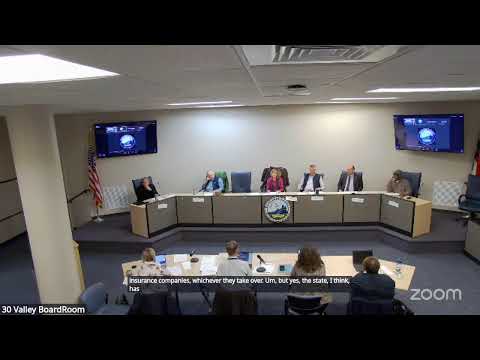
The Buncombe County Planning Board reviewed proposed phase‑one, life‑safety changes to the county’s flood damage prevention ordinance on Feb. 16 as staff sought permission to advance the draft to a public meeting in March and to the Board of Commissioners in April. Angela Lee, Buncombe County’s floodplain administrator, led the presentation of ZPH‑2025‑00042 and said the changes aim to reduce development and floatable hazards in the floodway.
"These standards are intended to expand the definition section, reduce construction in the floodway, and reduce temporary structures in the floodway," Lee said, summarizing the package. The board voted by voice to advance the draft so staff can publish formal text and hold a public hearing next month.
Why it matters: staff and board members said storms including Hurricane Helene and Tropical Storm Fred produced large debris and floatables that damaged downstream property and sometimes blocked bridges. The proposed edits are designed to protect conveyance (the channel and adjacent lands reserved to pass base‑flood discharge), close allowances that have permitted small additions in a hydraulically sensitive "conveyance shadow," and simplify enforcement of temporary‑use rules.
Key changes explained by staff include: - Conveyance shadow: the proposal tightens the county definition and would prohibit new development within a conveyance shadow inside the floodway; staff cited FEMA guidance that such allowances should be limited to minor additions but said Buncombe intends to restrict conveyance‑shadow development in the floodway. - Repetitive loss: the ordinance would add a definition consistent with NFIP practice — a building with two or more separate paid flood claims whose total exceeds the property’s value, or four or more claims of $5,000 or more since 1978 — to help the county track and prioritize high‑risk properties. - Letter of Map Change (LOMC) and local fill standard: staff proposed clarifying that any fill used to change flood maps must meet Buncombe County’s higher local standard of 2 feet above base flood elevation (BFE), not just the federal baseline. - Substantial improvement and historic variance: the draft clarifies that substantial improvement (repairs, reconstruction or additions that in any 12‑month period equal or exceed 50 percent of market value) remains subject to the county’s variance process for designated historic structures; staff cited the Biltmore Cottage as a recent example that went through the board of adjustment. - Emergency Action Plans (EAPs) for temporary structures: the revision would remove the word "nonresidential" from existing language so all temporary structures and stored materials in the floodplain must provide a one‑page EAP describing the permitted period, contact for removal, a removal timeframe prior to an event, documentation of the removal contractor, and a relocation site. Lee said the requirement can be a single sheet in the application packet. - Temporary storage and travel trailers in the floodway: the draft would bar new travel trailers or travel‑trailer parks from encroaching into the floodway and would prohibit temporary storage of floatable materials (mulch, lumber, containers, sheds) and junk vehicles in floodways and non‑encroachment areas.
Board members discussed practical enforcement issues. One member noted that the NFIP defines temporary units as road‑ready (on wheels) and that permanent storage sometimes requires anchoring; staff said the county’s clarification targets short‑term commercial RV/trailer rental models and storage that poses a downstream collision risk.
Lee noted federal programs available to participating communities. "The NFIP program is a FEMA‑run federal program to provide flood insurance to property owners in participating communities, as well as hazard mitigation funds," she said, and referenced FEMA hazard‑mitigation grants such as the Increased Cost of Compliance and HMGP that can fund elevations or acquisitions for substantially damaged properties.
What the board decided: after discussion, a motion to advance the amendments to a public meeting in March passed by voice vote. No ordinance changes were adopted at the meeting; staff will publish the proposed text and bring a formal public hearing packet to the board next month before forwarding to the Board of Commissioners.
Next steps: staff will circulate the annotated ordinance language and slide deck at the March public meeting and, if the board approves, send the adopted draft to the Board of Commissioners for consideration in April.