Get Full Government Meeting Transcripts, Videos, & Alerts Forever!
Get email alerts on the Zoning topic
No spam. Unsubscribe anytime.
Planning Commission recommends sign code changes to allow temporary 'feather' signs and more tenant wall signs
Summary
The Lompoc Planning Commission voted Feb. 11 to recommend zoning code amendments to Chapter 17.316 that would permit temporary feather signs for certain development projects and allow tenants in multi-tenant buildings at least one wall sign per building face; Williams Homes said changes are needed to market its 257-unit River Terrace project, while commissioners debated proliferation and First Amendment constraints.
The Lompoc Planning Commission on Feb. 11 voted to recommend to city council amendments to the city’s zoning code (Chapter 17.316) that would revise temporary sign standards and amend permanent wall-sign rules for multi-tenant buildings.
City staff described a two-part package. The first, driven by a developer application, would add an exemption to allow feather signs (temporary lightweight fabric signs on a single vertical pole or portable mount), create a table for temporary sign standards in residential zones and permit certain portable and construction/subdivision signs on project sites equal to or greater than one acre. The second, city-initiated amendment would allow tenants in multi-tenant buildings to have at least one sign per building face. Staff said the amendments include redline edits and are exempt from CEQA under staff-cited provisions (staff referenced CEQA §15061 and §15311 in their presentation).
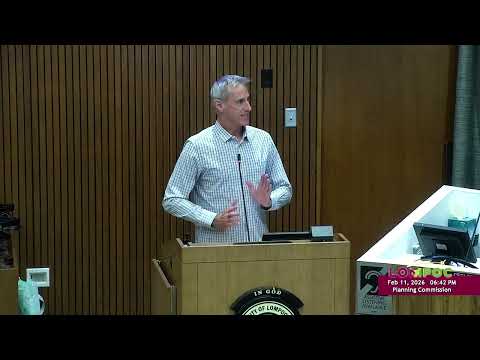
Mike Badger of Williams Homes, the project applicant, told the commission his team encountered limits in the current ordinance while preparing to market the River Terrace project, a 257-unit development. "We went out to do our sales and marketing efforts, and we found that your sign ordinance didn't really allow for temporary sales and marketing signage for new developments," he said, adding that adopting the amendment would let their sales operation and future developments use temporary onsite signage consistent with the code.
Commissioners pressed staff on details. Commissioner Beverly asked for the code definition of a feather sign and staff read the definition: a temporary sign constructed of cloth, canvas, plastic, fabric or similar lightweight, nonrigid material supported by a single vertical pole mounted in the ground or a portable structure. Commissioners debated whether the request should have been handled through a project-specific temporary use permit rather than a blanket code change and expressed concern that allowing feather signs citywide could lead to proliferation. Staff said no new permit fees would be required and noted that sign regulations must be content neutral to comply with First Amendment jurisprudence; staff also said many of the feather signs currently seen around town technically violate the existing code.
Chair moved to adopt Resolutions Nos. 1024-26 and 1025-26 recommending approval of the temporary and permanent sign amendments to city council; the motion was seconded and the commission approved the recommendation by voice vote. The amendments, if adopted by the city council, would change the temporary and permanent sign rules described in the staff report and would be applied to qualifying future developments and multi-tenant buildings.