Get Full Government Meeting Transcripts, Videos, & Alerts Forever!
Get email alerts on the Energy Storage topic
No spam. Unsubscribe anytime.
Surry County approves 89‑MW Bear Island battery storage CUP and site agreement with safety and payment conditions
Summary
The Surry County Board of Supervisors voted to approve a conditional use permit and a siting agreement for an 89‑megawatt battery energy storage facility proposed by Bear Island Storage LLC, including a one‑time $300,000 payment, annual emergency payments and conditions for noise, traffic and emergency response training.
The Surry County Board of Supervisors voted to approve Conditional Use Permit 2025‑01 and a related site agreement for Bear Island Storage LLC, authorizing an 89‑megawatt battery energy storage system and an associated switchyard on a portion of a 416‑acre parcel in the Bacon’s Castle District.
Staff presentation said the applicant proposes siting the storage and switchyard on about 32.5 acres of the parcel, with a facility footprint described in plans as roughly 10 acres and a retained vegetative buffer of at least 100 feet. Planning staff cited the Surry County Zoning Ordinance (Article 3, §3302) and Chesapeake Bay preservation area rules in recommending conditions, and noted the planning commission recommended the CUP 10–0.
The board approved the CUP and then separately approved a siting agreement that documents statutory machinery‑and‑tools (M&T) tax treatment and voluntary payments the applicant offered. Staff estimated the first‑year M&T payment at about $153,360 under Virginia law, and presented a long‑term model that, over several decades, could generate roughly $6 million in M&T receipts under the exemption schedule. Voluntary payments in the draft agreement include a one‑time initial payment of $300,000 due within 30 days of site‑plan approval; an annual emergency‑response payment of $15,000 with a 3% annual increase; and a $250,000 package front‑loaded over four years (year 1: $100,000; year 2: $75,000; year 3: $50,000; year 4: $25,000) intended to bolster county emergency equipment and training.
Developers’ presentation and staff estimates said construction would generate temporary local employment (developer estimated 50–75 construction jobs), and construction deliveries would be concentrated (applicant estimated roughly 1–3 heavy vehicle deliveries per day over a 1–2 month window and 100–150 vehicle movements during peak construction). Staff said final traffic management will be coordinated with VDOT and included penalties in permit conditions for failure to meet traffic‑plan requirements.
Public commenters and several board members pressed the applicant and staff on safety and environmental questions. Resident Bob Jankosa warned that ambient noise—even if low in decibels—will be continuous and asked whether local emergency services have equipment and capacity to manage lithium battery fires and contamination; he asked who would pay for cleanup if contamination occurred. In response, Erica of Fire and Risk Alliance, an independent fire‑protection consultant, described industry practice and testing standards and said current best practice is to monitor and isolate a thermal‑runaway event and allow the battery fuel to burn off (the consultant referenced UL‑series battery testing standards in describing propagation testing and mitigation). The applicant said it will provide hazard‑response personnel, deliver first‑responder training, and design the site to meet the ordinance’s safety requirements.
Staff told the board that CUP conditions will require a noise study before final site plan approval, a traffic‑management plan coordinated with VDOT, retention of vegetation buffering, emergency‑services training (emergency services may request training as frequently as once per year under the permit condition), a posted public liaison for citizen questions, local‑hire and contractor recruitment requirements, and remediation/testing if an environmental contamination event occurred. Staff also noted that site plan review and required technical studies remain before construction may begin and estimated a typical site‑plan approval window of roughly 12 months following final approvals.
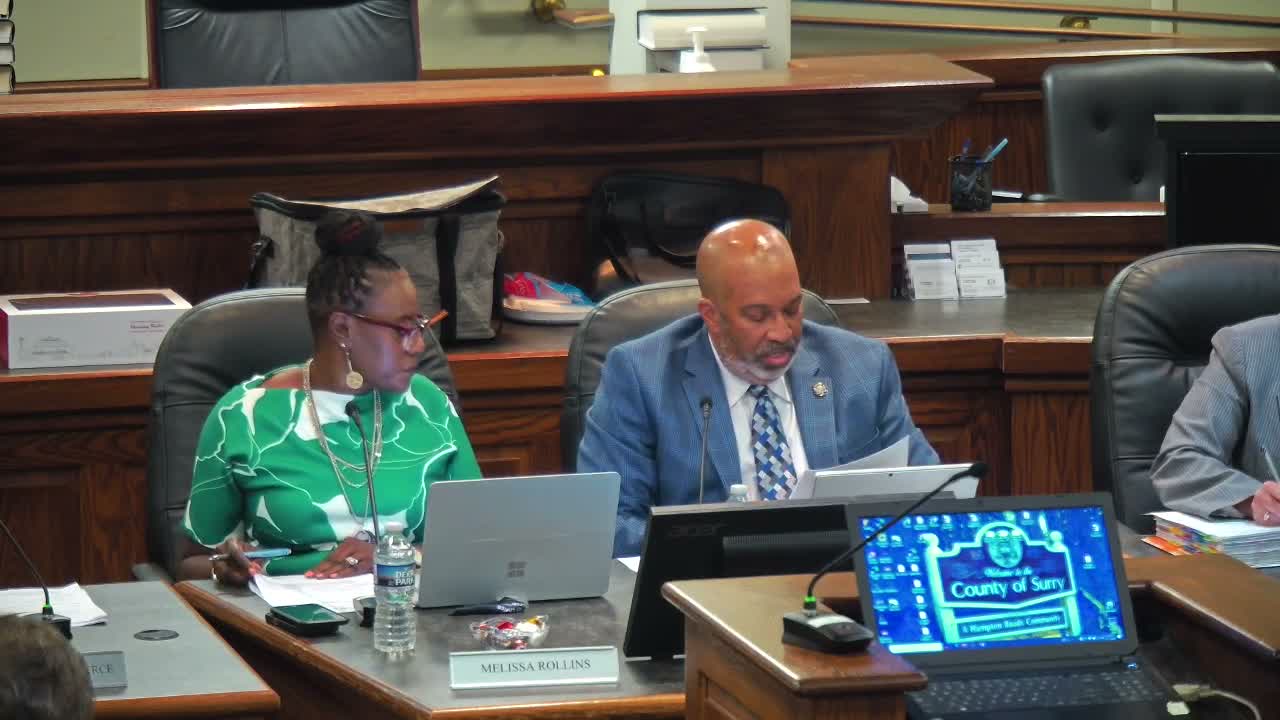
Board action: A motion to approve Conditional Use Permit 2025‑01 carried on a voice vote ('Aye'). The board then voted separately to approve the facility siting agreement. Votes were taken by voice; individual roll‑call tallies are not recorded in the transcript but the motions were announced as carried.
Next steps: The applicant will proceed to site‑plan submittal and technical studies required by the CUP conditions, after which the county will review compliance with noise, drainage, traffic and emergency‑response conditions before construction permits are issued.