Get Full Government Meeting Transcripts, Videos, & Alerts Forever!
Get email alerts on the Data Centers topic
No spam. Unsubscribe anytime.
Stafford supervisors debate data center setbacks, noise rules, taxes and utility obligations
Summary
At a work session, Stafford County staff outlined proposed comp‑plan and zoning changes for data centers (setbacks, tree preservation, sound‑study qualifications), while the board discussed tax treatment, valuation, utility investments (including a $400M reuse system), and the limited role data center revenue plays in the county’s five‑year financial plan.
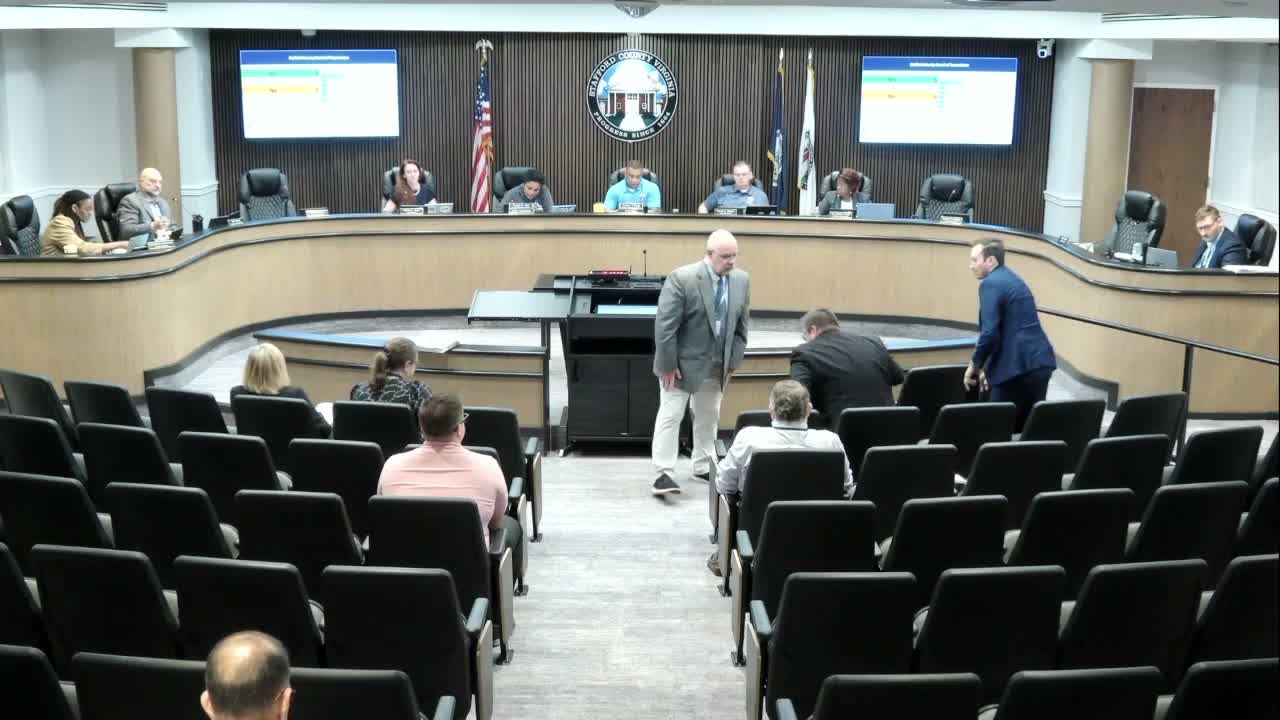
Staff and board members spent the bulk of a work session reviewing proposed comprehensive plan and zoning ordinance changes intended to manage data center development in Stafford County, and discussing the fiscal, environmental and service‑delivery implications of those policies.
Deputy County Administrator Donna Krauss opened the data center session by summarizing the evening’s packet, which included a comp‑plan amendment (Exhibit A), a draft ordinance, comparative jurisdiction charts and two illustrative policy options. Mike Zareff, Director of Planning and Zoning, said staff proposed one comp‑plan change (adding "building materials" to recommended noise mitigation measures) and four zoning ordinance revisions: increasing primary structure setbacks (board‑advertised options included up to 1,320 feet in some cases), broadening tree‑preservation language to prioritize existing trees, prohibiting generator testing on state holidays, and requiring sound studies be signed by a professional engineer certified by the Institute of Noise Control Engineering.
Board members pressed staff for specifics. Supervisor Allen asked how the ordinance would define a “mature” tree; planning staff recommended tying any definition to the county’s existing landscape manual credit threshold (4‑inch DBH). Several supervisors raised concerns about low‑frequency noise and vibration; staff said those issues may require more time and study to create defensible, enforceable standards and suggested reviewing Prince William County’s multi‑year effort as a model.
Andrea Light, the county CFO, presented the five‑year financial outlook and bond‑rating context. Light said the current five‑year plan does not assume any data center revenue and identified upcoming debt issuances (a $113.3 million standalone school bond and a $50 million transportation bond request) as the main drivers of debt service over the next decade. She described a three‑pronged approach staff will bring back for board policy consideration if data center revenues materialize: a data center revenue reserve, limiting reliance on recurring expenditures tied to volatile data center revenue, and directing remaining proceeds to capital projects.
Commissioner of the Revenue Scott Mayalski reviewed how the county values and taxes data center property. He recapped the region’s 2019 tax agreement (standardized depreciation schedules and a dollar‑1.25 tax rate used for recruiting), described the AWS performance agreement (signed January 2024) and explained a mechanism common in the region: the state‑level sales‑tax exemption for qualifying projects creates a 2:1 state grant match that applied to AWS. Mayalski explained that while real estate value is stable, business property (computer equipment) is volatile because of depreciation cycles; before buildings are completed the assessor uses a cost approach, and once operational the county may use an income approach when sufficient operating data exists. He said the county can audit self‑reported business property filings and coordinates with Loudoun and Prince William to validate filings.
Questions about utility and infrastructure implications drew substantive staff responses. Utilities staff explained that river withdrawals are regulated by the Virginia Department of Environmental Quality and that reuse systems can reduce new withdrawals. Staff estimated the reuse system at roughly $400 million and said developer contributions already under discussion would cover a portion of water/wastewater improvements (figures cited in the presentation included about $40–60 million of upgrades tied to project proffers and system enhancements); staff said if developer‑provided infrastructure did not materialize the county would need to add those projects to the CIP and find financing alternatives.
Board members also discussed implementation mechanics. Staff emphasized that many data center proposals will require rezonings and proffers, which the board can use to negotiate site‑specific mitigation and infrastructure commitments; proffers are voluntary offers from applicants and the board must weigh them when deciding whether to approve rezoning requests.
What’s next: staff will incorporate board input into materials for a joint public hearing with the planning commission scheduled for October 21. Staff also said it will provide additional language to clarify terms (for example, tree maturity and sound study qualifications), research neighboring localities’ experience, and supply further financial scenarios that show outcomes both with and without data center revenue.