Get Full Government Meeting Transcripts, Videos, & Alerts Forever!
Get email alerts on the Land Use topic
No spam. Unsubscribe anytime.
Spotsylvania supervisors direct staff to refine comprehensive-plan changes on growth boundaries and housing incentives
Summary
At a work session, Spotsylvania County's Board of Supervisors told planning staff to pursue detailed studies of two small Primary Development Boundary options and to draft code and policy language to implement net-acre density calculations and an optional "flex unit" incentive aimed at producing smaller, more attainable single-family homes while preserving neighborhood character.
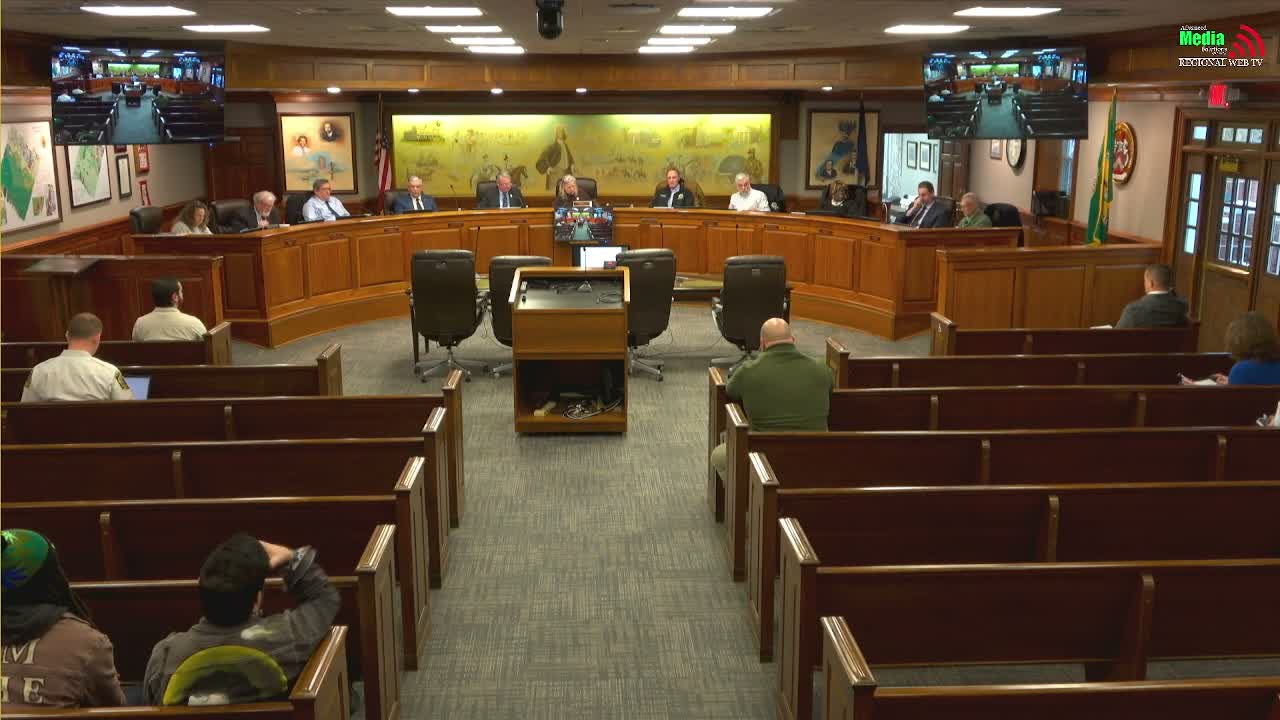
Spotsylvania County's Board of Supervisors spent most of a work session reviewing a five-year update to the county's comprehensive plan and gave staff direction to refine several policy proposals, including limited primary development boundary (PDB) expansions, tighter tourism-zone guidance and a new tool aimed at producing more affordable single-family homes.
County long-range planning staff presented the update (CPA 25-002) as a work session, saying the draft strives to align the plan's vision with the board's strategic goals and to guide zoning and capital investments through 2026. "The comprehensive plan establishes goals, objectives, policies, and implementation techniques that will provide the tools to help decision makers guide the county's future development," staff said during the presentation.
On PDB questions, staff recommended no major expansion but identified two limited study areas the board might consider: a roughly 200'to'300'acre area near Single Oak and Fry Lane north of Route 3 to support a developer-led connector road, and targeted private developer'funded water and sewer extensions to tourism uses near Thornburg and Indian Acres. "This idea is in no way attached to a river crossing," Supervisor Mullins told the board, adding the intent is to improve intra-county traffic flow rather than facilitate cross-river travel.
Board members asked staff to coordinate with utilities and the transportation committee to test feasibility and cost. Several supervisors emphasized any extension should be privately funded and limited in scope.
A second major change would alter how density is calculated. Staff proposed switching from the plan's current gross-acre methodology to a net-acre approach that excludes open space, wetlands and road rights-of-way from unit-yield calculations. Staff said the change reduces the number of lots that can be sited in the buildable footprint and avoids the "postage-stamp" lot pattern that has frustrated residents.
Building on that idea, planning staff proposed an optional "flex unit" incentive to increase attainable single-family options without replacing larger lots. Under the concept, a set percentage of lots within a low-density project (examples shown at 10%, 25% and 50%) could be converted to smaller "flex" lots with reduced lot-size and frontage requirements but a capped building envelope (proposed at about 1,600'1,800 square feet). Staff presented example scenarios showing overall lot yields that remained below what gross-acre calculations would have produced.
Supervisors broadly supported the net-acre calculation but expressed caution about large by-right increases in lot counts. "I would be more in favor of rezoning into something like this," Supervisor Lane said, arguing the flex option would be better routed through an alternative zoning district or rezoning so the board can require mitigation for infrastructure and school impacts.
Several board members raised operational concerns ' including impacts on schools, emergency services, road capacity and on-street parking ' and asked staff to return with targeted code language, GIS analysis identifying candidate areas within the PDB, and a cap on any by-right conversion percentages. Staff said they will proceed with drafting zoning options and bring the flex-unit concept and net-acre density change forward as part of the comprehensive-plan and zoning-ordinance updates.
The work session also covered small-area plan proposals (Thornburg/Jackson Gateway, Lake Anna, 4-Mile Fork) and urged tighter land-use language to protect long-established residential cores. The board did not adopt final map amendments at the meeting; staff will return with refined policy and ordinance language and schedule public hearings later in the adoption timeline.
The board's next regular meeting is Feb. 10, when staff will provide additional updates and the public will have further opportunity for input.